
Free Marketing & Seller Fee Calculators
HowCalculate is a set of free calculators for advertisers, marketers and online sellers. Use it to work out what your ads cost, whether they pay off, and how much Stripe or PayPal take from each sale. Every calculator shows its formula, a worked example and a plain explanation of the result, so you can check the math instead of trusting a number.
Written and reviewed by Ajay Kumar. Last reviewed October 2026.
Which calculator do you need?
Pick the question that sounds most like yours.
- “Are my ads paying off?” Use the ROAS calculator.
- “How much ROAS do I need to make a profit?” Use the Break-Even ROAS calculator.
- “Why are my ads so expensive?” Check your CPM and your CTR.
- “What does one sale cost me?” Use the CPA calculator.
- “What does a whole customer cost me?” Use the CAC calculator.
- “How much will Stripe take?” Use the Stripe fee calculator.
- “How much will PayPal take?” Use the PayPal fee calculator.
- “How much will Shopify take?” Use the Shopify fee calculator.
- “How much will Venmo take?” Use the Venmo fee calculator.
- “How much will Etsy take?” Use the Etsy fee calculator.
- “How much will TikTok Shop take?” Use the TikTok Shop fee calculator.
Marketing calculators
Ad and marketing metrics that follow your campaign from impressions to customers. See all marketing calculators.
Find your cost per 1,000 impressions, plan an ad budget, or see how many impressions a budget buys.ROAS Calculator
Find return on ad spend, break-even ROAS from your margin, ACoS, and the revenue you need for a target. Break-Even ROAS Calculator
Find the lowest ROAS where your ads stop losing money, from your price, costs and fees.CTR Calculator
Find your click-through rate from clicks and impressions, or work out clicks from a target CTR.CPA Calculator
Find your cost per acquisition, plan a budget, and see your break-even CPA from order value and margin.CAC Calculator
Find your customer acquisition cost from marketing and sales costs, and compare it with customer lifetime value.
Fee calculators
See what payment platforms really take, what lands in your account, and what to charge to receive a set amount. See all fee calculators.
See Stripe’s fee and your net payout on a sale, or what to charge to receive a set amount.PayPal Fee Calculator
See PayPal’s fee and your net payout on a sale, or what to charge to receive a set amount.Shopify Fee Calculator
Compare Basic, Grow and Advanced by plan fee, card fees and transaction fees, and see which plan costs you least.Venmo Fee Calculator
See what Venmo takes on a sale, a business payment or an Instant Transfer, or what to ask for to keep a set amount.Etsy Fee Calculator
See every Etsy fee on a sale, your profit and margin, or the price to charge to hit your profit goal.TikTok Shop Fee Calculator
See the referral fee, creator commission, ads and refunds on a TikTok Shop order, or the price to charge to hit your profit goal.
The five ad metrics in plain words
- CPM (cost per mille) is what you pay for every 1,000 times your ad is shown. Divide the cost by impressions, then multiply by 1,000.
- CTR (click-through rate) is the share of people who saw your ad and clicked it. Divide clicks by impressions.
- CPA (cost per acquisition) is what you pay in ad spend for one conversion, such as a sale or a sign-up. Divide ad spend by conversions.
- CAC (customer acquisition cost) is what it costs to win one new customer, counting sales and marketing costs together. Divide those total costs by the number of new customers. Companies draw the line in slightly different places, so each calculator and guide here spells out what it includes.
- ROAS (return on ad spend) is the revenue your ads bring back for each dollar spent. Divide ad revenue by ad spend.
One more number matters more than any benchmark: your break-even ROAS. It is 1 divided by your profit margin. At a 40% margin it is 2.5, and a campaign below that loses money on every sale even if the ROAS looks decent.
One example, start to finish
These metrics are links in a single chain, and it is easier to see when the same numbers run through all of them. Say a store spends $1,000 on ads.
The ads get 100,000 views and 1,000 clicks. 25 people buy, and together they spend $2,500.
Now the check. Suppose the store keeps a 40% margin. Break-even ROAS is 1 ÷ 0.40 = 2.5, so this campaign is exactly at break-even. Each $100 order leaves $40 of margin, and each sale cost $40 to win. The store covers its ad bill and earns nothing on top of it.
That is useful, because it tells you where to push. You can pay less to be seen (lower CPM), earn more clicks (higher CTR), or turn more clicks into buyers with a better page. Each calculator lets you change one number and see what happens to the result.
CAC goes one step further. If those 25 buyers are all new customers and the store spent another $500 that month on tools and freelancers, CAC is ($1,000 + $500) ÷ 25 = $60, which is $20 higher than the CPA. That is the number to compare with what a customer is worth over time.
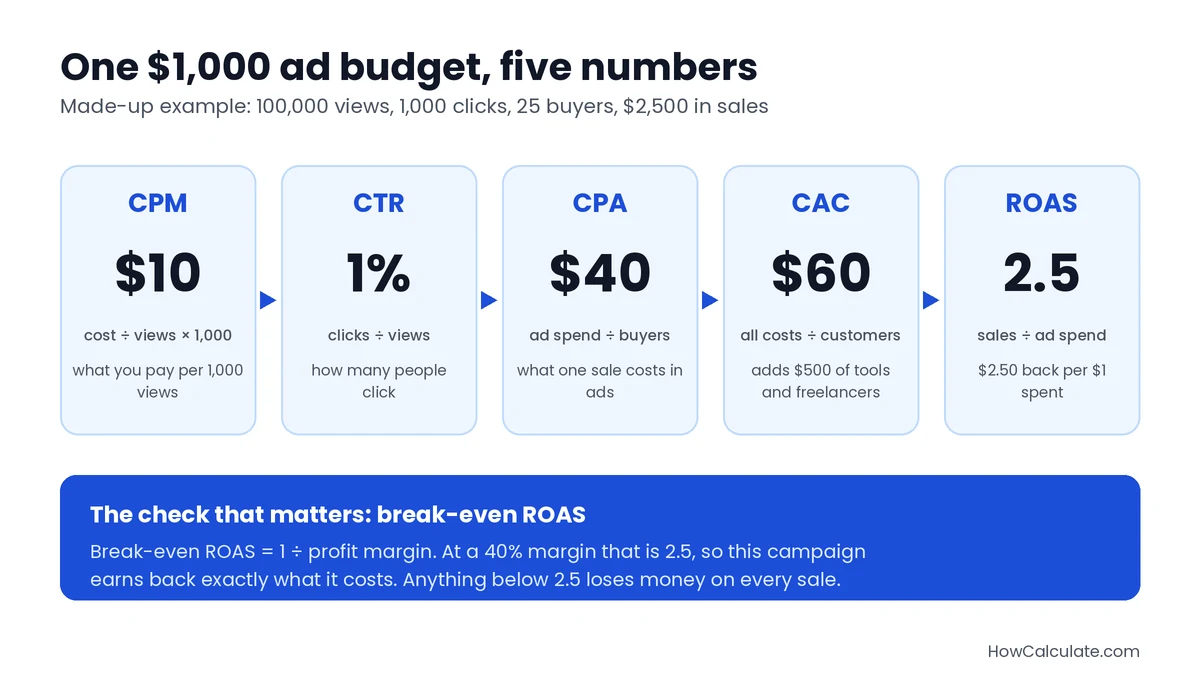
These figures are made up to show the method. They are not benchmarks. For real platform numbers, see our guides below.
What payment platforms really take
Most payment platforms charge a percentage plus a fixed amount per payment. The fixed part hurts small sales the most, so a fee that sounds small can take a real share of a $10 sale.
These are US rates, checked in October 2026. Here is what each platform takes from a $100 sale.
Both platforms have other rates for other payment types, and extras like international cards, currency conversion and disputes cost more. Check each platform’s own pricing page before you set a price, starting with Stripe’s pricing page.
The fee calculators do three jobs:
- They show the fee on a payment.
- They show what you receive after it.
- They work backwards: the price you need to charge to receive an exact amount. With Stripe’s standard rate, receiving $100 takes a charge of $103.30.
Latest guides
- How Much Does Etsy Take Per Sale?: every 2026 Etsy fee, a real $25 example, what Etsy takes from a $100 sale and how to keep more.
- TikTok Shop Payout Schedule 2026: when sellers actually get paid, the 5 settlement tiers, reserves and why new shops wait 31 days.
- TikTok FBT: What Fulfilled by TikTok Costs: the 2026 US fee per unit, free storage, the free shipping rule and when FBT is worth it.
- Is Etsy Plus Worth It? The Real Cost After Credits: what the $10 subscription costs once credits are counted, and who should skip it.
- Selling on Etsy vs eBay: Which Leaves You More?: real fees on both at $10 to $300, and when Etsy’s Offsite Ads make eBay the cheaper choice.
- Etsy vs Shopify: Which Costs Less?: the order count where Shopify’s fees drop below Etsy’s, and what fees leave out.
- Average TikTok Shop Affiliate Commission: typical rates by category, TikTok’s 1–80% limits, and the most your product can afford.
- How Much Does TikTok Shop Take From Sellers?: the 6% fee on a $25 sale, refunds, and when your payout arrives.
- Is TikTok Shop Worth It? What a $30 Sale Really Leaves You: what a creator and ads do to your profit on one order.
- Are Etsy Offsite Ads Worth It? Do the Profit Math First: the 15% and 12% fee on $20, $40 and $100 items, and when to opt out.
- Venmo Goods and Services vs Friends and Family: when to use each, what Purchase Protection covers, and scams to avoid.
- Shopify Payments vs Stripe Fees: what 400 orders really cost with each one.
- CAC vs CPA: what each one measures, and which one to track.
- Break-Even ROAS: how to work out the ROAS your ads need before they make money.
- YouTube CPM vs RPM: why you earn less than the CPM you see, with worked examples.
- What Are Stripe Fees? What You Actually Pay on $10,000 in Sales: a 200-order month line by line, plus the extras people forget.
- CAC Formula: Why Your Number Is Probably Too Low: the costs most people leave out, and how to set a target.
- What Is a Good CTR?: real numbers for Meta, Google, YouTube and TikTok.
- How to Calculate CPA: the formula, worked examples and benchmarks.
- Average CPM by Platform: what Meta, TikTok, YouTube and others charge.
- What Is a Good ROAS?: benchmarks by platform and industry.
Why trust these calculators
Every number on this site comes with its working, so you never have to take a result on faith.
Formulas you can check
Every page shows the formula behind the result, with worked examples you can follow.
Sourced numbers
Fee rates and benchmarks come from named sources, with the date they were last checked.
Tested by hand
Each calculator is tested against hand-worked examples before it goes live.
Private by design
The calculators run in your browser. Nothing you type is sent anywhere.
Frequently asked questions
What is HowCalculate?
HowCalculate is a free website of calculators and guides for online advertisers, marketers and sellers. It covers ad metrics like CPM, CTR, CPA, CAC and ROAS, and the fees that payment platforms like Stripe and PayPal charge.
Are the calculators free?
Yes. You do not need an account, and nothing is locked behind a payment.
Do you save the numbers I type in?
No. The calculators work in your browser, and the figures you enter are not sent to us or stored. Like most websites, we do use standard analytics and advertising, which our privacy policy explains.
What is the difference between CPA and CAC?
CPA counts only the ad spend needed to get one conversion. CAC counts all the sales and marketing costs of winning one new customer, including things like salaries, tools and agency fees, so it is usually higher.
What is a good ROAS?
It depends on your profit margin, not on one universal number. Your break-even ROAS is 1 divided by your margin, so at a 40% margin you need at least 2.5. Above that, your ads are covering the cost of the product and the ad spend, and what is left helps pay for everything else. Our ROAS guide has benchmarks by platform.
How do I work out how much Stripe or PayPal will take?
Multiply the sale by the percentage, then add the fixed fee. At Stripe’s standard US rate that is the sale × 2.9% + 30¢. The Stripe fee calculator and the PayPal fee calculator do the math for you.
How current are the fee rates?
Each calculator page shows the date its rates were last checked against the platform’s own pricing. Platforms change prices, so treat any rate as a guide and confirm it before you act.
Is this financial or legal advice?
No. The calculators and guides are general information. For decisions about money, tax or contracts, speak to a qualified professional.
About HowCalculate
Meet Ajay Kumar
I’m an SEO strategist and content writer with more than four years of experience. I built HowCalculate because most online calculators give you a number and nothing else. Here, every result comes with its formula, a worked example and a source.
About the siteContact meReady to run your numbers?
Pick a calculator and get your answer in seconds.