Average CPM by Platform: Meta, TikTok, YouTube and More
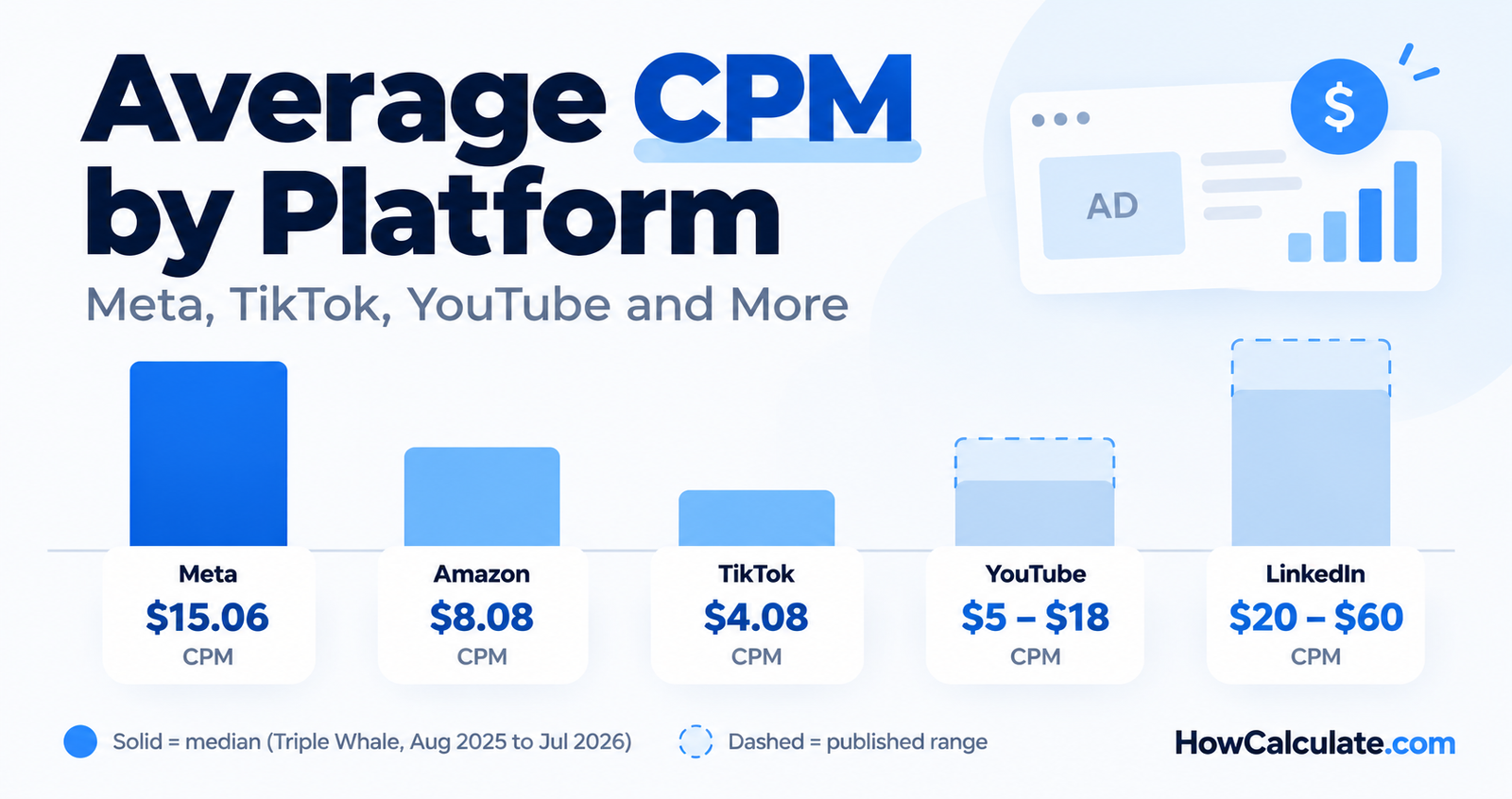
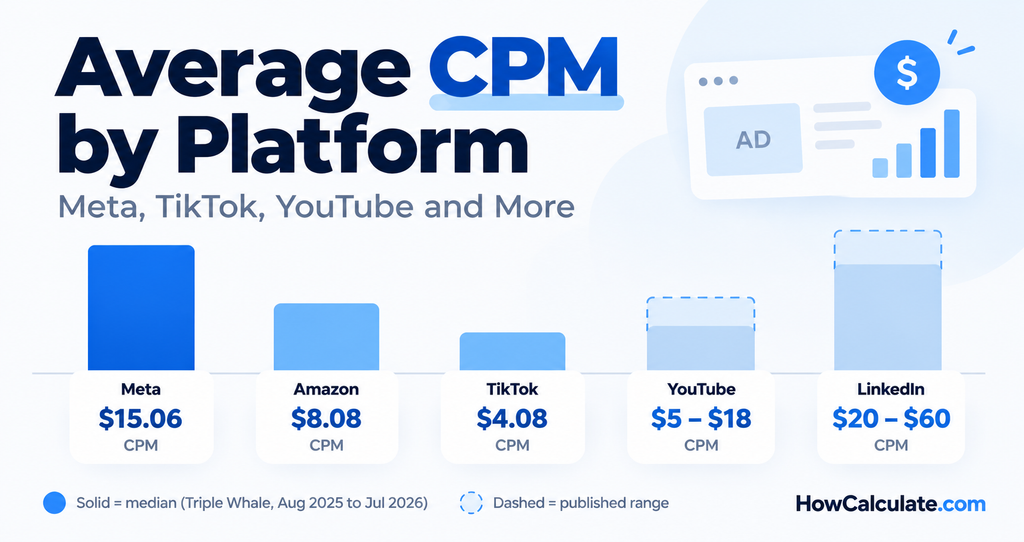
There is no single average CPM. In the latest ecommerce data, the median CPM is $15.06 on Meta, $8.08 on Amazon and $4.08 on TikTok. YouTube and LinkedIn don’t share official averages. Published roundups put YouTube at roughly $5 to $18 and LinkedIn at $20 to $60 for every 1,000 impressions.
This guide shows what each platform costs, which numbers are solid and which are rough, what $1,000 gets you, and why YouTube’s CPM and RPM are not the same thing. You can try your own numbers in the CPM calculator.
Table of Contents
Average CPM by platform at a glance
| Platform | Typical CPM | What the number is |
|---|---|---|
| Meta (Facebook and Instagram) | $15.06 | Median, 40,000+ ecommerce brands, Aug 2025 to Jul 2026 |
| Amazon Ads | $8.08 | Median, 2,800+ brands, same period |
| TikTok | $4.08 | Median, 5,900+ brands, same period |
| YouTube | about $5 to $18 | Range from published roundups |
| about $20 to $60 | Range from published roundups | |
| Google Display | about $0.50 to $6.40 | Range from published roundups |
The first three are measured medians from one company, Triple Whale, so you can compare them with each other. The rest are ranges from agency articles. Treat those as rough guides.
What is CPM, and how do you work it out?
CPM means cost per mille, which is the cost for 1,000 ad impressions. An impression is one time your ad is shown.
CPM = ad cost ÷ impressions × 1,000
Say you spend $500 and your ad is shown 40,000 times. Your CPM is 500 ÷ 40,000 × 1,000 = $12.50.
You can also go the other way. A $2,000 budget at a $12 CPM buys about 166,667 impressions. The CPM calculator works out all three: CPM, total cost and impressions.
You may also see vCPM. It only counts impressions that were actually viewable on the screen, so it’s usually higher.
What $1,000 buys at each median CPM
- Meta ($15.06): about 66,400 impressions
- Amazon ($8.08): about 123,800 impressions
- TikTok ($4.08): about 245,100 impressions
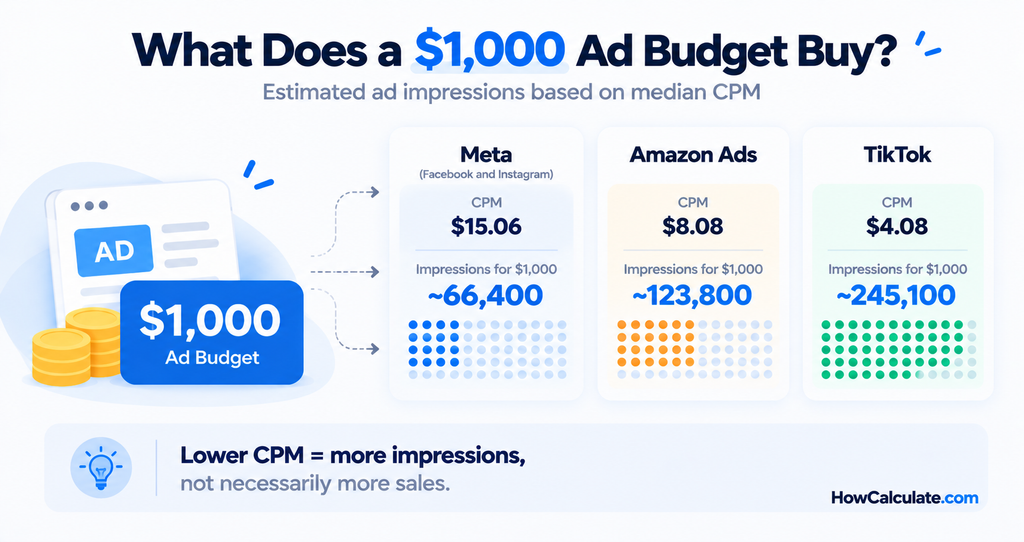
TikTok’s median is about 73% lower than Meta’s, so the same money shows your ad almost four times as often. But more views are not the same as more sales. More on that below.
Meta (Facebook and Instagram) CPM: $15.06 median
In Triple Whale’s data, Meta’s median CPM was $15.06 from August 2025 to July 2026. A year earlier, it was $13.30, so it went up 13.24%.
Sixteen of the 17 industries got more expensive. Only E-learning & Online Courses got cheaper (down 6.61%). Health & Wellness had the highest CPM at $21.80, and Baby had the lowest at $11.50. Books & Music rose the fastest, up 33.33% to $14.01.
You’ll see lower Meta numbers on other sites. One roundup reports a median of $7.26 across all accounts. That’s because it includes many kinds of advertisers, while Triple Whale only counts ecommerce brands. Neither number is wrong. They measure different people.
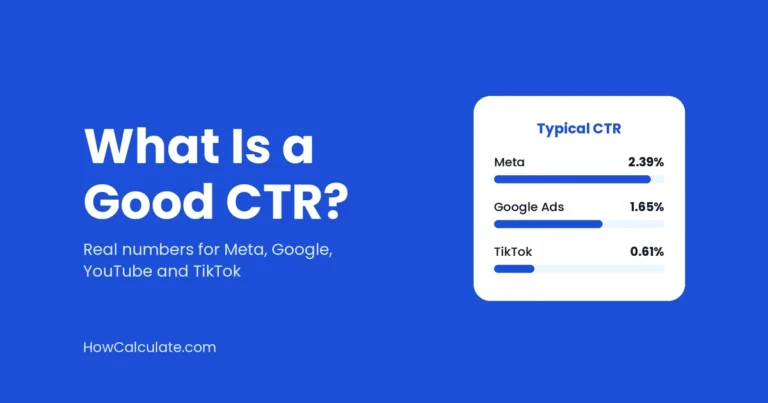
Here’s what that CPM means per click. At a $15.06 CPM and Triple Whale’s median click-through rate of 2.39%, the cost per click works out to about $0.63. Medians don’t fit together perfectly, so use that as a rough guide. You can check your own click-through rate with the CTR calculator.
TikTok CPM: $4.08 median in the latest report
Triple Whale’s TikTok report says the median CPM is $4.08. A year earlier it was $5.71, so it fell by about 28% (my calculation from those two figures).
The industries are close together. Home & Garden is the highest at $4.61, then Pets & Animals at $4.59. The gap between the cheapest and the most expensive is only $1.15.
Other sources give higher numbers. Lebesgue reports $4.80, WebFX reports $9.16, and Triple Whale’s earlier report, which covered 2025, said $13.26. That big gap shows why a CPM benchmark needs a clear dataset and time period. For planning, pick the benchmark that best matches your platform, goal, country and dates. Don’t blend these numbers into one range.
Amazon Ads CPM: $8.08 median (read with care)
Triple Whale reports a median Amazon CPM of $8.08. Most Amazon ads are bought by the click, so read this as an effective CPM, meaning the cost of the impressions you actually received. It isn’t a price you set. Don’t compare it directly with Meta’s $15.06.
It’s also rising fast. A year earlier it was $5.81, so it went up 39.18%. That was the biggest jump of any number in Triple Whale’s Amazon report.
If you want to work out an effective CPM yourself, one roundup gives this formula: CPM = click-through rate × cost per click × 1,000. For example, a 0.5% click-through rate and a $1.20 cost per click give 0.005 × 1.20 × 1,000 = $6.00.
If you sell on Amazon, ACoS and ROAS matter more than CPM. The ROAS calculator shows both.
Average YouTube CPM (and how it differs from RPM)
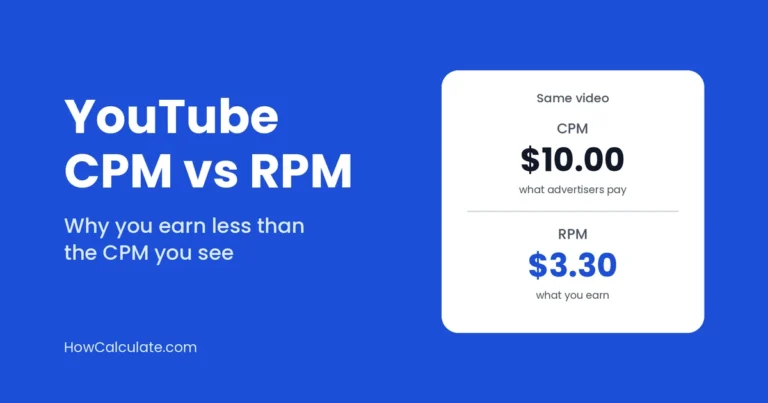
Many people who search for the average YouTube CPM are creators, not advertisers. That causes a lot of confusion, because YouTube uses two different numbers:
- CPM is what advertisers pay for 1,000 ad impressions, before YouTube takes its share.
- RPM is what a creator earns for 1,000 views, after YouTube takes its share. It also counts views that didn’t show an ad.
YouTube’s own help page explains that RPM is lower than CPM for those two reasons. For long videos, creators get 55% of net ad revenue on the watch page.
Here’s an example, not a promise for any channel. If the CPM is $10 and 60% of views show an ad, the RPM is about 10 × 0.55 × 0.60 = $3.30.
I couldn’t find an official YouTube average CPM. The roundups don’t agree:
- Prooflytics: $5 to $15 for in-stream ads.
- Stackmatix: $6.20 to $12.40 for skippable ads, $8.80 to $16.20 for non-skippable ads, and $4.20 to $8.60 for Shorts.
- Understory, quoting Digital Applied for Q1 2026: $11.42 for skippable ads, $14.85 for non-skippable ads, $9.20 for bumper ads and $4.85 for Shorts.
- The Jonas Agency: $10 to $18.
The pattern is clear, though. In-stream ads cost roughly $6 to $16 per 1,000 impressions, and Shorts cost less, at about $4 to $9. So the average YouTube CPM is roughly $5 to $18, depending on the ad type and the source.
LinkedIn CPM: published ranges
LinkedIn is among the most expensive major platforms. Roundups put its CPM at about $20 to $60. One Q1 2026 benchmark reports an average of $33.80 across industries and $37.55 for B2B software companies.
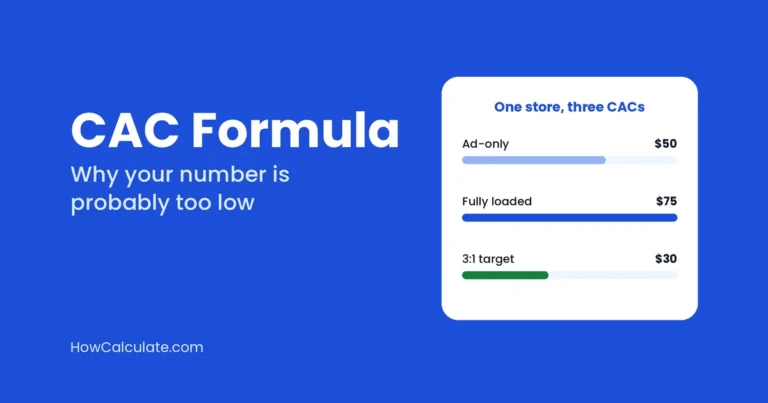
You pay more because you can target people by job title and company. A high CPM can still be worth it if one customer is worth a lot. Check it against your customer acquisition cost before you decide. Our CAC formula guide explains how to work out what a customer is really costing you.
Google Display, Pinterest, Snapchat and Reddit
I don’t have measured medians for these, only ranges from roundups:
- Google Display: $0.50 to $2.00 (Prooflytics), $2.80 to $6.40 (Stackmatix), and $3.12 (Digital Applied, quoted by Understory).
- Pinterest: $3 to $10 (Hubfluence), and $4.20 to $8.80 (Stackmatix).
- Snapchat: $2.50 to $8 (Hubfluence), and $5 to $12 (Prooflytics).
- Reddit: about $4 to $12, which Understory describes as a directional range.
Display is usually the cheapest way to get seen. But it also tends to get fewer clicks, so cheap impressions don’t always bring visitors.
Why you see different CPM numbers on different sites
- Who is measured. Meta is $15.06 for ecommerce brands but about $7 across all accounts.
- The campaign goal. Reach, traffic, and sales campaigns cost different amounts.
- The time period. Even Triple Whale’s TikTok number changed from $13.26 to $4.08 between two reports.
- The country. CPM can vary a lot between countries because advertiser competition, buying power, and audience demand all differ.
- Median or average. A few very expensive campaigns can pull an average up.
- What counts as an impression. A normal impression and a viewable one are different.
So choose the benchmark that fits your own business, and be careful with any single “average.”
What changes your CPM
- Your audience. Small or popular audiences cost more, because more advertisers want them.
- Busy seasons. Prices usually go up when many brands advertise, like the end of the year.
- Your ad. Ads that people like and engage with tend to cost less.
- Where it shows. Video, feed, and display ads are priced differently.
- Your goal. Sales campaigns often cost more per 1,000 impressions than reach campaigns.
Is a lower CPM always better?
No. CPM only tells you what reach costs, not what it earns.
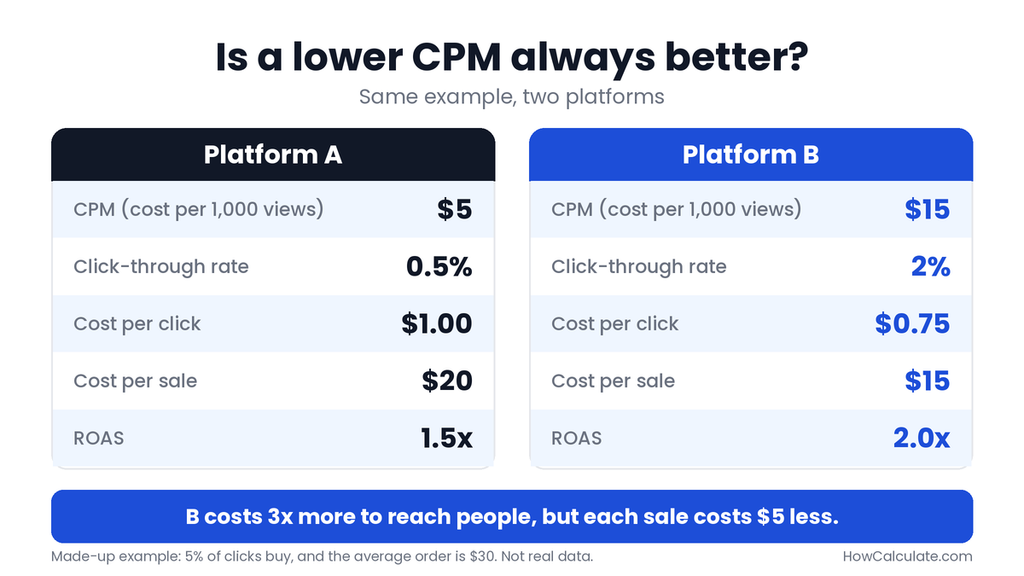
Say Platform A has a $5 CPM and a 0.5% click-through rate. Your cost per click is $1.00. Platform B has a $15 CPM, three times higher, but a 2% click-through rate. Your cost per click is only $0.75. Platform B is more expensive to reach people, but cheaper per visitor, because far more of them click.
The formula is cost per click = CPM ÷ (1,000 × click-through rate). What matters most is what happens after the click. Judge a platform by its cost per acquisition and its return on ad spend. Our guide on what a good ROAS is explains the second one.
How to lower your CPM
- Try wider audiences. Very narrow targeting often pushes prices up.
- Refresh your ads. Tired ads get shown less efficiently.
- Test different placements and formats, and drop the ones that cost more without bringing more results.
- Avoid the busiest dates unless you have a good offer.
- Work on your click-through rate. A better one can lower your real cost per click. See what a good CTR is on each platform.
Frequently asked questions
What is the average CPM?
There isn’t one number. In the latest ecommerce data, the median CPM is $15.06 on Meta, $8.08 on Amazon and $4.08 on TikTok. Roundups put YouTube at about $5 to $18 and LinkedIn at $20 to $60.
What is the average CPM on Facebook?
For ecommerce brands, Triple Whale’s median Meta CPM (Facebook and Instagram together) is $15.06. Sources that include all kinds of advertisers report lower numbers, around $7.
What is the average CPM on TikTok?
Triple Whale’s latest median is $4.08. Other published figures run from about $4.80 to $13.26. The difference comes from the dataset, the period and the campaign goal, so use the benchmark closest to your own market and goal.
What is the average CPM on YouTube?
YouTube doesn’t publish an official number. Published roundups put the average YouTube CPM at about $5 to $18. In-stream ads are around $6 to $16, and Shorts are around $4 to $9.
What is the difference between CPM and RPM on YouTube?
CPM is what advertisers pay for 1,000 ad impressions, before YouTube’s share. RPM is what a creator earns for 1,000 views after that share, including views with no ad. So RPM is always lower.
What is a good CPM?
It depends on your platform and on what a click or a sale is worth to you. A lower CPM isn’t always better. Judge it by cost per click, cost per acquisition and ROAS.
Which platform has the cheapest CPM?
Among the measured medians, TikTok is the cheapest at $4.08. In the roundups, Google Display has the lowest ranges.
Why are CPMs going up?
In Triple Whale’s latest reports, Meta’s median rose 13.24% and Amazon’s rose 39.18% from the year before. TikTok’s fell in that report, so it isn’t the same everywhere.
How do you calculate CPM?
Divide your ad cost by your impressions, then multiply by 1,000. A $500 spend over 40,000 impressions is a $12.50 CPM.
Work out your own CPM
Put your numbers into the HowCalculate CPM calculator to find your CPM, your budget or your impressions, then compare the result with the numbers above. To see how every step connects, from reach to revenue, browse all the marketing calculators.
How I found these numbers
The Meta, TikTok, and Amazon medians come from Triple Whale’s published reports, which cover August 1, 2025 to July 31, 2026: the Meta report, the TikTok report and the Amazon report. The CPM and RPM definitions come from YouTube’s help page. The YouTube, LinkedIn, display, Pinterest, Snapchat and Reddit ranges come from the roundups named in the text, and they are rough guides, not official averages. The “$1,000 buys” numbers, the cost-per-click examples and the platform comparison are my own calculations, which I rechecked.
These numbers are reference points, not targets or guarantees, and nothing here is financial advice.
By Ajay Kumar, SEO strategist and content writer. Last updated: October 7, 2026