What Is a Good CTR? Real Numbers for Meta, Google, YouTube and TikTok
You open your ad dashboard and see a CTR of 1.2%. Is that good? Should you be worried, or happy?
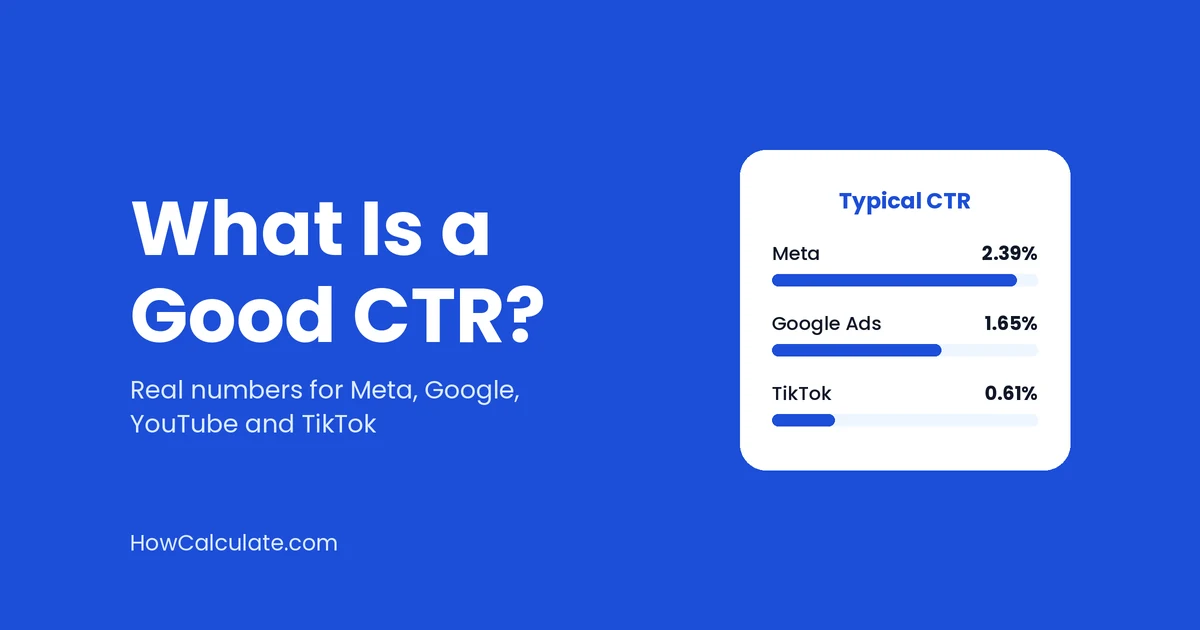
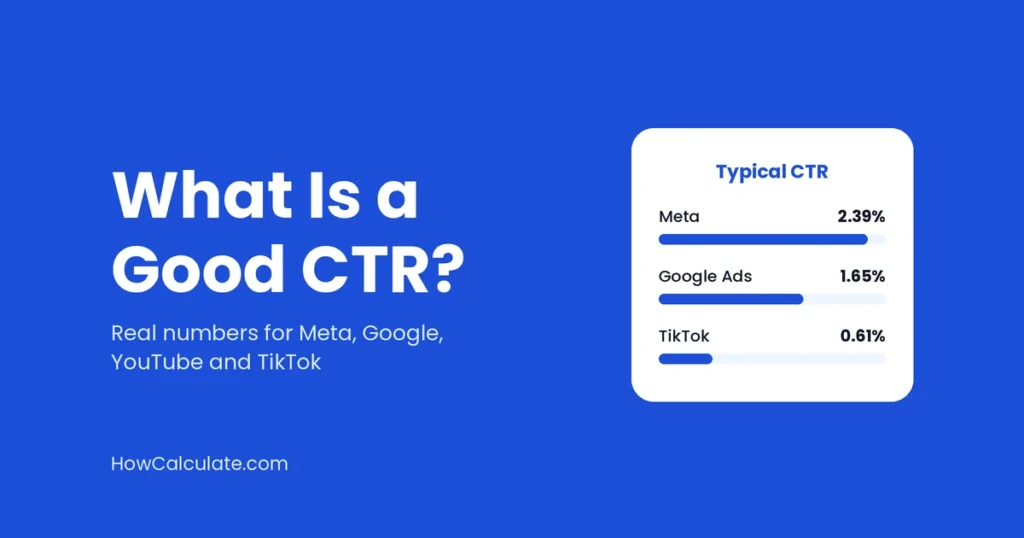
It depends on where the ad ran. A 1.2% click-through rate is below the typical Meta benchmark (about 2.39%), below the Google Ads figure in Triple Whale’s ecommerce data (about 1.65%), and well above the TikTok median in the same dataset (about 0.61%). That is why “what is a good CTR?” has no single answer, and why most guides on it leave you more confused than before.
This guide gives you the real numbers for each platform, explains why they differ, and shows you how to work out the CTR your own business needs.
Want to check your own number first? Try the CTR calculator.
The short version
- CTR is clicks divided by impressions, times 100.
- On Meta, about 2% to 3% is a useful benchmark.
- On Google Ads, Triple Whale’s ecommerce data shows about 1.65% overall, while WordStream’s US search-ad average is 6.64%.
- YouTube says half of all channels and videos have an impressions CTR between 2% and 10%.
- In Triple Whale’s ecommerce benchmarks, TikTok sits at about 0.61% and Amazon at about 0.56%.
- A high CTR only helps if those clicks turn into sales.
What CTR actually means?
CTR stands for click-through rate. It is the percentage of impressions that resulted in clicks. If your ad is shown 1,000 times and 20 of those impressions get a click, your CTR is 2%. The other 980 were scrolled past.
Advertisers use it to see whether an ad grabs attention. YouTubers use it to judge a thumbnail. SEO people use it to see how often a search result gets clicked.
How to calculate CTR?
Divide clicks by impressions, then multiply by 100.
CTR = (clicks ÷ impressions) × 100
Say your ad was shown 10,000 times and got 250 clicks. 250 ÷ 10,000 = 0.025, so your CTR is 2.5%.
Two small tips. Use the same date range for both numbers. And use impressions, not reach. Reach counts people, while impressions count how many times the ad was shown. If you don’t want to do the math yourself, the CTR calculator does it in a second.
Average CTR by platform
These numbers come from big benchmark reports. They use different brands and dates, so treat them as rough ranges, not targets.
| Platform | Typical CTR | Source |
| Meta (Facebook, Instagram) | about 2.39% (median) | Triple Whale |
| Google Ads, overall (ecommerce brands) | about 1.65% | Triple Whale |
| Google Ads, search campaigns (US) | about 6.64% (average) | WordStream |
| YouTube | 2% to 10% for half of channels and videos | YouTube Help |
| TikTok | about 0.61% (median) | Triple Whale |
| Amazon Ads | about 0.56% (median) | Triple Whale |
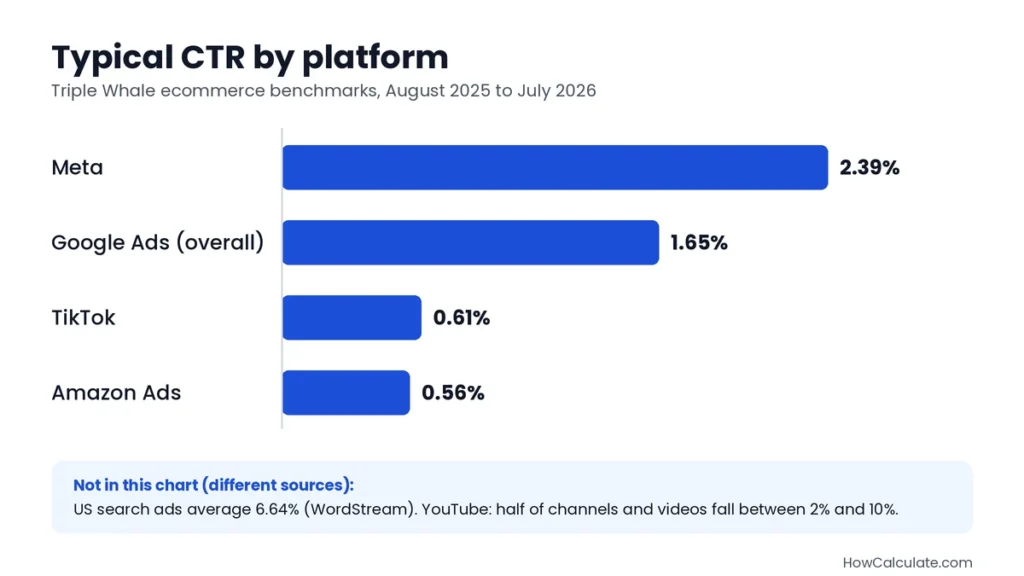
Search ads tend to get a higher CTR, because someone typed what they want and your ad answers it. Social ads interrupt people who came to see something else.
What is a good CTR for Facebook ads?
The latest Triple Whale industry figures for Meta range from 1.88% to 3.02%, with a median of about 2.39%. So 2% to 3% is a useful benchmark for many Meta campaigns. If you are under 1%, take a closer look at your creative and your audience.
What is a good CTR for Google Ads?
You will see two very different numbers, and both are right, because they measure different things.
Triple Whale’s data covers ecommerce brands across all Google Ads campaign types and shows about 1.65% overall, up from about 1.45% a year earlier. WordStream’s 2026 benchmarks looked only at US search campaigns (13,474 of them, from April 2025 to March 2026) and found an average of 6.64%.
The two figures aren’t directly comparable. One covers Google’s broader campaign mix in an ecommerce dataset, while the other covers US search campaigns only.
Your industry matters too. In the WordStream study, Arts & Entertainment led at 12.75%, and Automotive repair sat near the bottom at 5.56%.
What is a good CTR on YouTube?
YouTube says half of all channels and videos have an impressions CTR between 2% and 10%. That is a wide range on purpose, because CTR changes with the type of content, the audience and where the video was shown.
Two things worth knowing:
- Where impressions come from can affect CTR. A video shown mainly on the homepage can have a lower CTR than one shown mostly to people already browsing your channel.
- Clickbait backfires. A misleading thumbnail can lift CTR but cut watch time, and YouTube is less likely to recommend videos that people leave quickly.
What is a good CTR for TikTok and Amazon ads?
In Triple Whale’s ecommerce data, both sit below 1%. TikTok is at about 0.61% and Amazon Ads at about 0.56%. That is far lower than Meta’s 2.39%, so a 1% CTR that looks weak on Meta would be above the median on either of these platforms.
Because the numbers sit so far apart, compare your CTR with the same platform’s benchmark, never with Meta’s.
Why a low CTR is not always bad?
Some ads are not meant to get clicks. Display and video ads tend to have lower CTR. Awareness campaigns aim for reach. Retargeting ads often do better, because the people seeing them already know you.
The reverse is also true. A high CTR can still be bad. A funny ad can pull lots of clicks from people who never buy, and you pay for every one of them.
The CTR you actually need
Here is the question I think matters more: what CTR do you need to make money?
Step 1: find the maximum CPC you can afford. Say your break-even CPA is $32 and 2% of clicks turn into purchases. Your maximum CPC is $32 × 0.02 = $0.64.
Step 2: find the CTR that gets you there. Needed CTR = CPM ÷ (1,000 × max CPC). With a $15 CPM, that is 15 ÷ (1,000 × 0.64) = 0.0234, so you need about 2.35%.
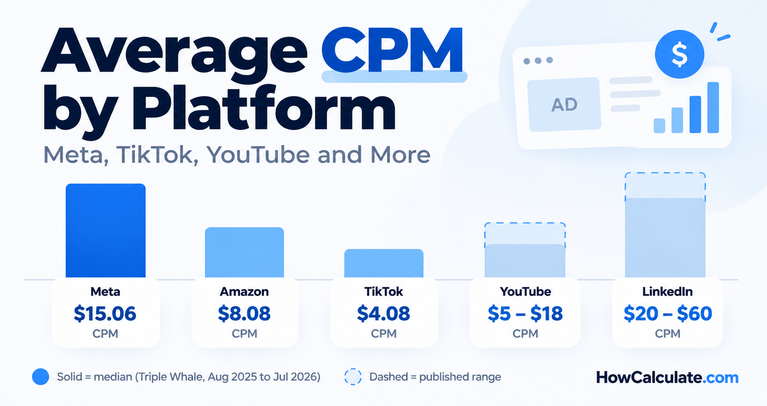
Here is why it matters. Your cost per click is CPM ÷ (1,000 × CTR). At a $15 CPM, a 1% CTR costs $1.50 per click, and a 2% CTR costs $0.75. Same ad, half the cost per click.
If these terms are new, read our guides to CPM and CPA, and use the CPA calculator to find your break-even number.
How to improve your CTR?
- Lead with the main benefit. Put what the person gets in the first line, or the first second of a video.
- Match the ad to the audience. A message for everyone speaks to no one.
- Test one thing at a time. Change the headline or the image, not both.
- Refresh tired ads. If CTR drops while frequency climbs, people have seen the ad too often.
- Use a clear call to action. “Get the free checklist” beats “Learn more.”
- For search ads, use the words people typed in your headline.
- For YouTube, promise only what the video delivers.
After every change, check your ROAS, not just CTR. To see what a customer really costs you once clicks convert, our CAC formula guide is the next step.
Common CTR mistakes
- Comparing your CTR with a number from another platform or industry.
- Judging a campaign by CTR alone.
- Mixing up impressions and reach.
- Changing many things at once, then not knowing what worked.
- Calling a test after a few hundred impressions. Small samples swing wildly.
CTR FAQ
What is a good CTR for Facebook ads?
About 2% to 3% is a useful benchmark. The Triple Whale median for Meta is about 2.39%.
What is a good CTR for Google Ads?
It depends on the dataset. Triple Whale’s ecommerce data shows about 1.65% across all campaign types, while WordStream’s US search-ad average is 6.64%.
What is a good CTR on YouTube?
YouTube says half of all channels and videos have an impressions CTR between 2% and 10%. It varies with content type, audience and where the video is shown.
Is a 1% CTR good?
On Meta it is below the typical range. In Triple Whale’s TikTok and Amazon data, it is above the median. It depends on the platform.
Is a higher CTR always better?
No. It only helps if clicks turn into customers. Check conversion rate and CPA too.
How do I calculate CTR?
Clicks ÷ impressions × 100. For 250 clicks and 10,000 impressions, CTR is 2.5%.
Check your own CTR
Enter your clicks and impressions in the CTR calculator. Then follow the numbers on to cost per customer with the CPA calculator.
How I found these numbers
I used Triple Whale’s ecommerce benchmark reports (brands running ads, August 2025 to July 2026) for Meta, Google Ads, TikTok and Amazon. For search ads I used WordStream’s 2026 Google Ads benchmarks (13,474 US search campaigns). For YouTube I used YouTube’s own help page on impressions and CTR. Benchmarks move, so I recheck them and update the date at the top. The “CTR you actually need” math is my own, and you can test it with the calculators above.