CAC Formula: Why Your Number Is Probably Too Low (and How to Fix It)
Table of Contents
Ask a store owner what it costs to win a customer and you’ll usually get the ad number. “$50,” they say, because that’s what the ad dashboard shows. Then you add the designer, the email tool, and the part-time marketer, and the real answer is closer to $75. The CAC formula is simple. Getting the right numbers into it is where almost everyone slips.
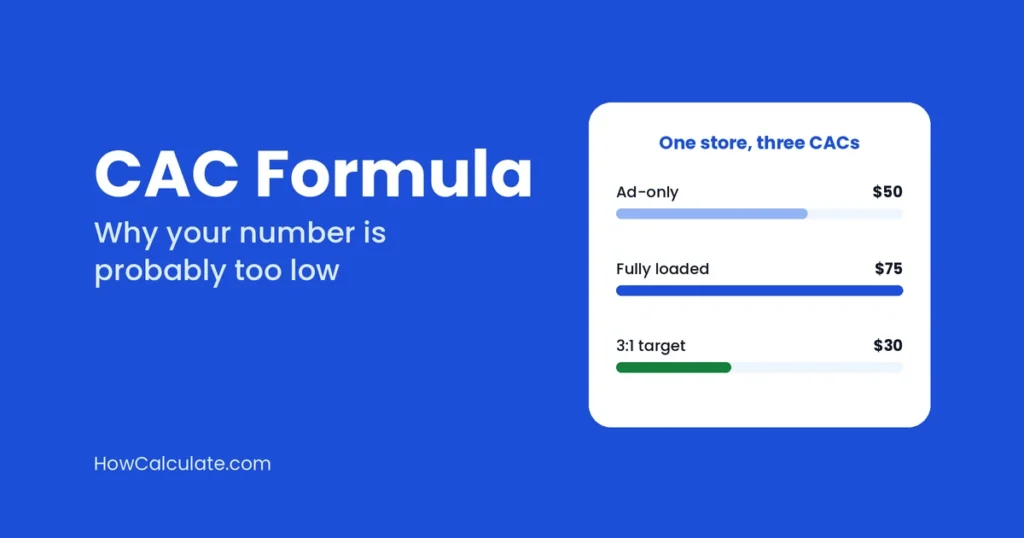
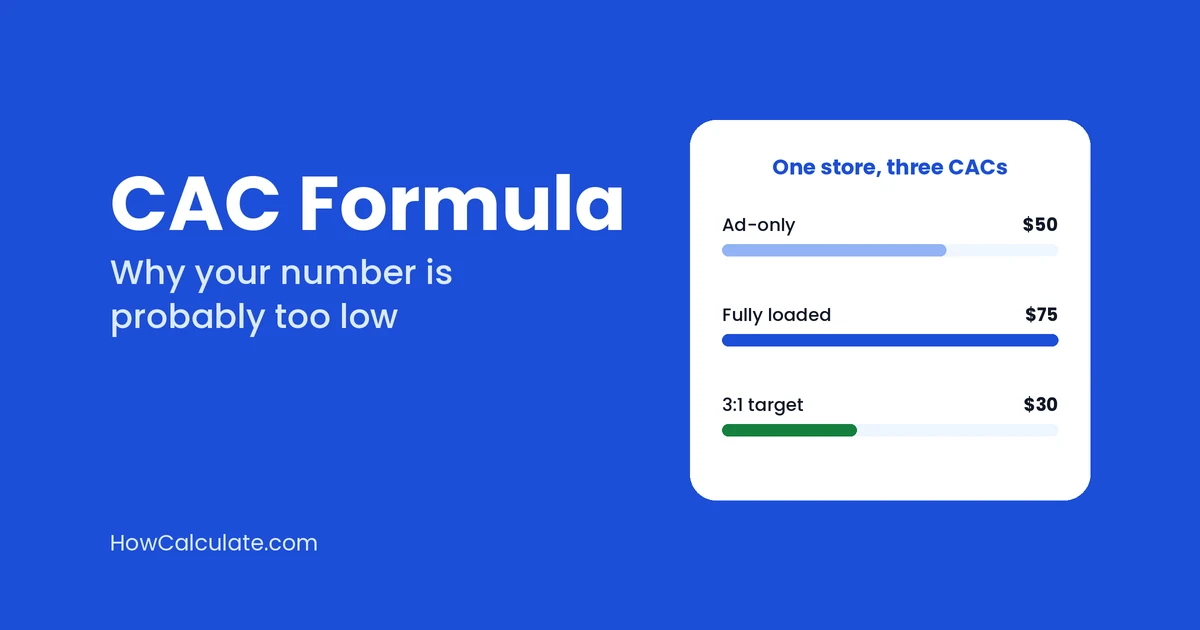
Here is one online store, in one month, with three different CAC numbers:
| Number | What it means | Value |
|---|---|---|
| The ad-only number | Ad spend ÷ new customers | $50 |
| The fully loaded number | Sales and marketing costs ÷ new customers | $75 |
| The 3:1 target | CAC target based on a $90 customer lifetime value | $30 |
Only the last two help you decide what to do tomorrow. The first one just feels good. This post walks through all three, because most guides stop at the formula and never tell you whether your result is any good.
If you’d rather skip ahead and run your own figures, the CAC calculator has one box for marketing costs and one for sales costs.
The CAC formula, in one line
CAC = total sales and marketing cost ÷ number of new customers
Customer acquisition cost is what it takes, on average, to win one new paying customer. Use the same time period for both numbers, such as one month, and count only new customers. Wall Street Prep uses the same definition.
The formula is easy. The trouble is in the top half of the fraction, which is where the $50 and the $75 come from.
Number 1: the flattering $50
Here is our store’s month. It spent $4,000 on ads and won 80 new customers.
$4,000 ÷ 80 = $50
That is a real number. It’s just not your CAC. It’s your cost per customer from ads, and plenty of people stop here because it’s the number the ad dashboard hands them.
Number 2: the honest $75
Now count what the store really spent to get those 80 customers:
- $4,000 on ads
- $600 for a designer to make the ad images
- $100 for an email tool
- $1,300 for a part-time marketer
That’s $6,000.
$6,000 ÷ 80 = $75
A good rule is to count everything you wouldn’t be paying for if you weren’t trying to win customers. That usually means:
- Ad spend on every channel
- Salaries and freelancer fees for marketing and sales, plus commissions
- Marketing and sales tools, like your email software and CRM
- Content, design and video work
- Events, travel and agency fees
Brian Balfour’s guide, published on Andrew Chen’s site, says the same: leaving out salaries, overhead and tools is one of the most common mistakes. A few costs are debatable, like free trials or customer success work that helps sell. Pick a rule, write it down and keep it the same every month. A CAC you can compare over time beats a perfect one you can’t.
Number 3: the $30 target
This is the number almost nobody works out, and it gives your CAC something to be measured against.
Start with what a customer is worth. For our store:
- An average order is $60 and the profit margin is 50%, so each order earns $30
- A typical customer buys 3 times, so their lifetime value (LTV) is $30 × 3 = $90
LTV is the profit one customer brings you over time. Harvard Business School Online says an LTV-to-CAC ratio of 3 or higher is generally seen as attractive, with 1 to 2 meaning you’re barely breaking even or only slightly ahead. Below 1, a customer’s lifetime profit doesn’t cover what it cost to win them.
To reach a 3:1 LTV-to-CAC ratio, the store should aim for a CAC of about LTV ÷ 3:
$90 ÷ 3 = $30
Why 3? It’s a rule of thumb, not a law. The idea is that a third of the lifetime profit pays back the cost of winning the customer, and the rest covers your other costs and leaves you something to keep. Treat $30 as a useful target to aim at, not a hard limit.
Put the three numbers side by side
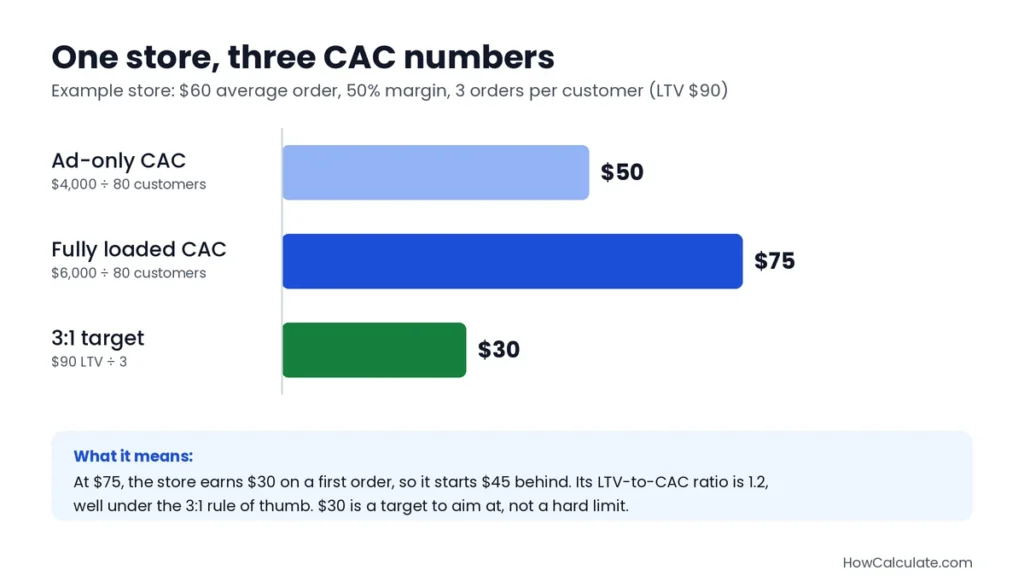
The store pays $75 to win a customer. On the first order it earns $30. That puts it $45 in the hole on day one. Only after the third order does it get the money back, and then it’s up just $15 before any other business costs.
- Its ratio is $90 ÷ $75 = 1.2. That’s thin.
- To reach 3:1 at a $75 CAC, a customer would need to be worth $225, which is 7 to 8 orders instead of 3.
So the store has three ways out. It can cut CAC toward $30, raise how often customers buy, or raise the profit on each order. Looking only at the $50, it would never have known there was a problem.
What to do with your ratio?
Once you have your own LTV ÷ CAC, here is how I’d read it:
- Below 1: a customer’s lifetime gross profit does not cover the acquisition cost, before considering other business expenses. Don’t scale yet. Fix the offer, the price or the channel first.
- Between 1 and 3: you might be fine, but it’s tight. Work on repeat purchases and landing pages before you add budget.
- 3 or higher: you have room. This is when more spending usually makes sense, as long as the ratio holds when you scale.
That advice is mine, not a law of nature. The cutoffs come from the HBS rule of thumb, and your own cash, margins, and risk level matter too.
Is your CAC lying to you?
Run through these before you trust any number:
- Did you leave out salaries or tools? Your CAC is too low.
- Are repeat buyers counted as new customers? Same problem. It makes CAC look better than it is. Count only people who bought for the first time.
- Do your spend and customers cover the same period? If your sales cycle is two months, September’s ads may win October’s customers. For short cycles, like many online stores, a monthly calculation is fine. For longer ones, group customers by when they were won or use one consistent method, and don’t change it between periods.
- Do you know which “blended” number you’re looking at? Blended CAC usually means total costs divided by new customers from all channels together. Channel CAC looks at one channel, like Google Ads or SEO. Definitions vary across businesses, so always check what the numerator and denominator include. For this guide, CAC means fully loaded sales and marketing costs divided by new paying customers. Track upsells and expansion separately.
- Is a low CAC hiding bad customers? If cheap customers leave after one order, the low number is a trap. Always check LTV next to it.
How fast does it pay back?
Payback tells you how many months a customer takes to cover their own acquisition cost:
Payback (months) = CAC ÷ monthly gross profit per customer
Take a subscription product with a $240 CAC. The customer pays $40 a month and your gross margin is 60%, so you keep $40 × 0.60 = $24 a month.
$240 ÷ $24 = 10 months
Whether 10 months is fine depends on your cash, how long customers usually stay and your business model. A shorter payback frees up cash sooner. A longer one ties it up. I haven’t found one target that works for every business, so I won’t pretend there is one.
For SaaS, the formula is the same. Include sales salaries and commissions along with marketing, count only new sign-ups, and use monthly recurring revenue times gross margin for the payback.
CAC vs CPA, quickly
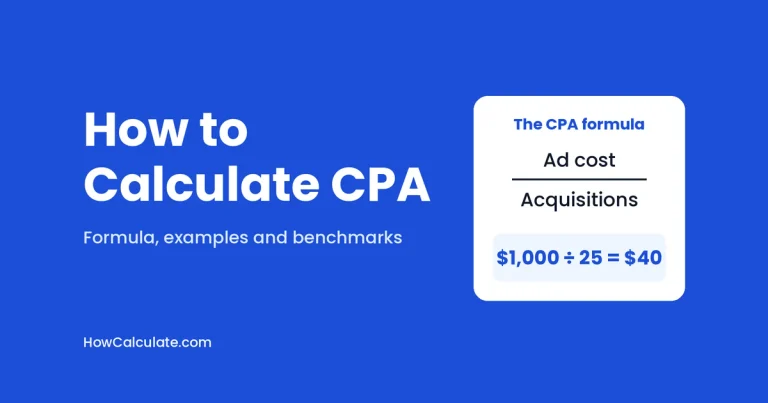
CPA is the cost of one result from a campaign, and that result can be a sale, a lead or a sign-up. CAC is the cost of one paying customer across the whole business. Bloomreach draws the same line: CPA is campaign-level, CAC is business-level. For the campaign side, see how to calculate CPA.
Bringing CAC down without breaking things
- Compare channels, then check quality. Look at CAC by channel, but check retention and LTV before you move budget to the cheapest one. A low CAC isn’t a good result if those customers leave quickly.
- Work on your CTR and landing page. Stronger ads can lower your cost per click, and a better landing page turns more visits into customers. See what a good CTR is, and track the whole path to CAC rather than CTR alone.
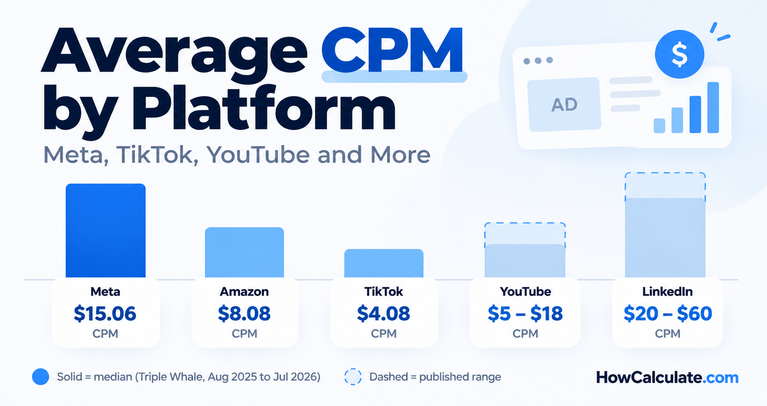
- Watch what you pay for impressions. If reach is expensive, look at average CPM by platform.
- Raise LTV. Email, loyalty offers and win-backs make the same CAC look better.
- Check that ads pay back. Pair this with ROAS, so growth doesn’t cost more than it earns.
Quick questions
What is the CAC formula?
Total sales and marketing cost divided by the number of new customers in the same period.
What is a good CAC?
One that sits well below what a customer is worth. A common rule of thumb is that LTV should be at least 3 times CAC.
What is the average CAC?
There isn’t a single one. It varies a lot by industry and business model, so compare your CAC with your own LTV instead of someone else’s number.
Should salaries go into CAC?
Yes. The time of the people who market and sell is a real cost, and leaving it out makes CAC look lower than it is.
What is CAC payback?
How many months a customer takes to generate enough gross profit to cover what it cost to win them.
Run your own numbers
Add up everything you spent to win customers, count only the new ones, then compare the result with what a customer is worth. The CAC calculator does the first part in a few seconds. Put ads, tools and marketing salaries in the marketing box, and sales salaries and commissions in the sales box.
Where do these numbers come from?
The formula and cost list follow the CAC guides from Wall Street Prep, Brian Balfour on Andrew Chen’s site and Bloomreach. The 3:1 LTV-to-CAC rule of thumb comes from Harvard Business School Online. The store and subscription examples use made-up numbers that I calculated myself.