What Are Stripe Fees? What You Actually Pay on $10,000 in Sales
Table of Contents
Sell something for $10, and $9.41 lands in your Stripe balance. The missing 59 cents isn’t a glitch. It’s the fee, and on a small sale it takes a bigger bite than most people expect.
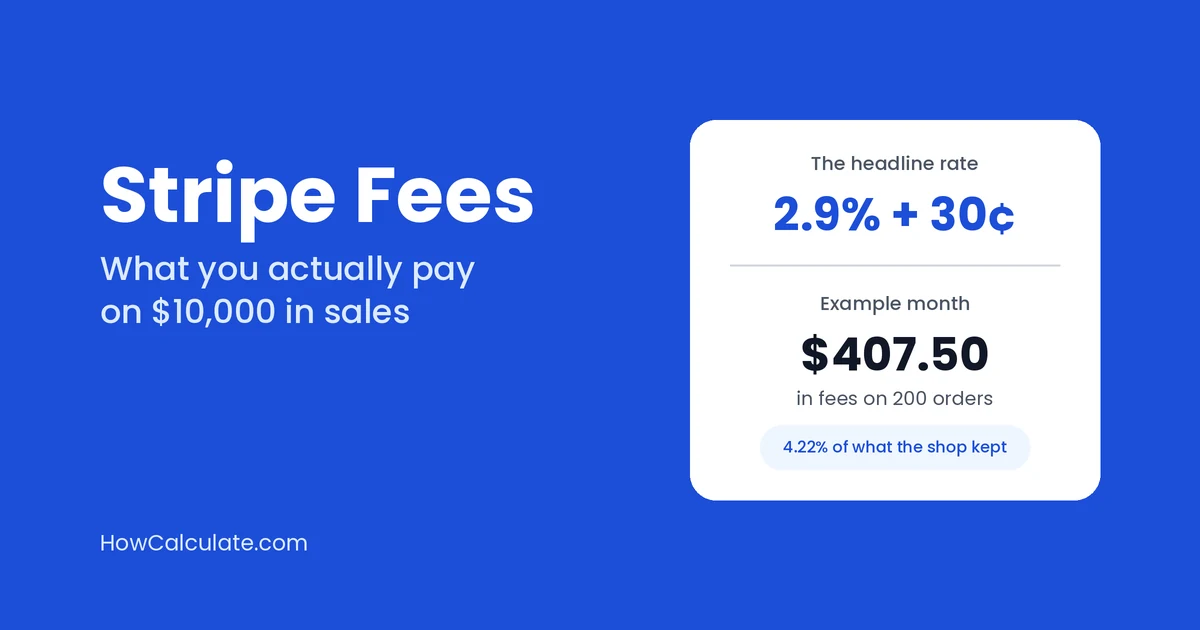
So, what are Stripe fees? For a standard US online card payment, Stripe charges 2.9% plus 30 cents per successful payment. There’s no setup fee or monthly fee on standard pricing. You pay Stripe processing fees on successful payments, while disputes and optional services can add other costs. That’s the headline, and it’s accurate. But a few extras can stack on top of it, and some costs don’t come back when you refund.
This guide shows the basic fee, the extras, and then a made-up month of 200 orders added up line by line, so you can see what a seller can end up paying. If you only want a quick answer for one payment, the Stripe fee calculator does it in seconds.

The basic fee, and why small sales cost more?
Here’s how the 2.9% + 30¢ looks on three different sale sizes:
| Sale | Stripe’s fee | You keep | Fee as % of sale |
|---|---|---|---|
| $10 | $0.59 | $9.41 | 5.9% |
| $50 | $1.75 | $48.25 | 3.5% |
| $200 | $6.10 | $193.90 | 3.05% |
The percentage part stays at 2.9%, but the flat 30 cents hits small sales much harder. That’s why a store selling $10 items feels the fee far more than one selling $200 items.
The rates above come straight from Stripe’s pricing page for US accounts. Other countries have different rates.
The extras that stack on top
The 2.9% + 30¢ is the starting point. According to Stripe, these can be added:
- International cards: +1.5%
- Currency conversion: +1%, when it’s needed
- Manually entered cards: +0.5% (typing in a card number yourself)
- In-person payments: 2.7% + 5¢ for domestic cards on Stripe Terminal, instead of the online rate
They add together. A US business taking an international card in a foreign currency pays 2.9% + 1.5% + 1% = 5.4% plus 30 cents.
Stripe also takes its percentage from the whole amount that goes through, which includes things like sales tax or tips if they’re part of the charge. PayCompass explains this in more detail.
A 200-order month, line by line
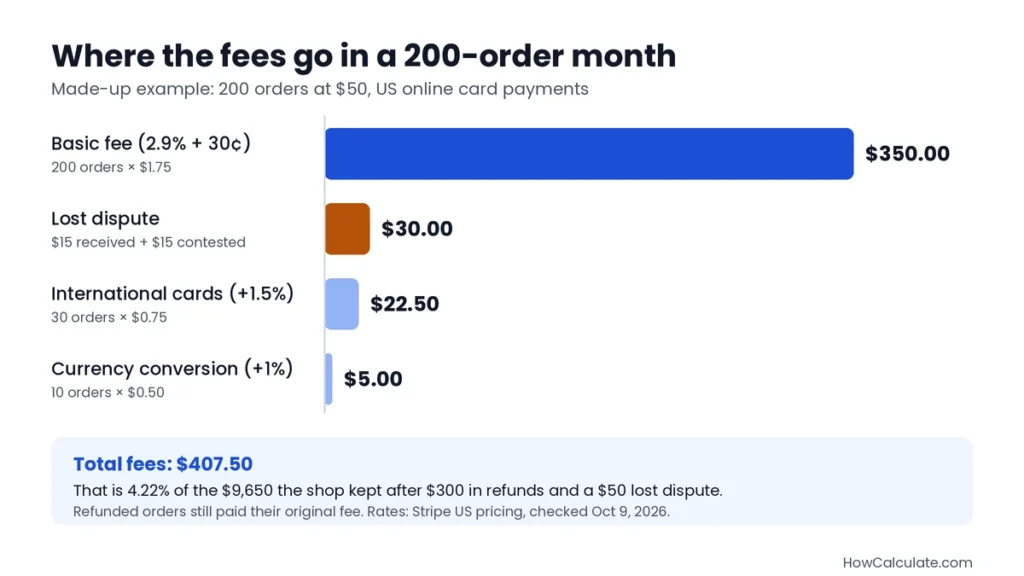
How much does Stripe take in a month? Here is the answer for a made-up shop. In one month it has:
- 200 orders at $50 each, so $10,000 charged
- 30 orders paid with international cards
- 10 of those in a foreign currency
- 6 refunds
- 1 dispute (a chargeback) that the shop fought and lost
This example assumes all 200 payments are successful $50 online card charges, with no manually entered cards or optional-service fees. The 10 currency-conversion orders are included among the 30 international-card orders.
The fees add up like this:
- Basic fee: 200 orders × $1.75 = $350.00
- International cards: 30 orders × $0.75 (1.5% of $50) = $22.50
- Currency conversion: 10 orders × $0.50 (1% of $50) = $5.00
- The lost dispute: $15 when the dispute arrives, plus $15 for contesting it = $30.00
Total fees: $407.50.
Now look at what the shop kept. It handed $300 back in refunds, and the lost dispute returned another $50 to the customer. So it kept $9,650 before fees, and after fees it has $9,242.50.
That makes the effective cost $407.50 ÷ $9,650 = 4.22% of the money the shop actually kept. The “3.5% on a $50 sale” in the headline only covers the first line of the list.
The fees people forget
Refunds don’t return your fee. Stripe doesn’t charge to refund most payments, but it doesn’t give back the original processing fee either. In the example, the 6 refunded orders cost $10.50 in fees (6 × $1.75) on money the shop no longer has.
Disputes cost real money. Stripe charges $15 for each dispute you receive. If you respond, there’s another $15 countered fee, and that second one is refunded only if you win. On top of that, a lost dispute takes the sale amount back.
Instant payouts have a fee. Stripe’s pricing page lists a fee for instant payouts: 1.5%, with a minimum of 50 cents.
Other products cost extra. If you use Stripe’s invoicing or billing tools, they have their own fees on top of payment processing. They’re worth checking on the pricing page before you turn them on.
How to pay less?
- Offer bank payments on big invoices. Stripe’s ACH Direct Debit costs 0.8%, capped at $5. On a $2,000 invoice, a card costs $58.30, while ACH costs $5. On a $500 invoice, the card fee is $14.80 and ACH is $4.00. Bank payments usually take longer to clear than card payments, so check that works for your customers.
- Don’t key in cards by hand when you can avoid it. That adds 0.5%.
- Only convert currency when you must. The extra 1% adds up on international sales.
- Fight disputes you can win, and let go of ones you can’t. Contesting a lost case costs you the extra $15.
- Ask about custom pricing if your volume is high. Stripe offers custom pricing to some businesses, so it’s worth asking once you process a lot.
Should you pass the fee on to customers?
Some sellers add the fee to the price so they receive the full amount. To get a set amount after fees, charge (target + $0.30) ÷ (1 − 0.029). For $100 after fees, that’s $103.30.
Be careful with how you present it. Card networks and some states have rules about surcharges, so check the rules before you add a separate fee line to a checkout. Building the cost into your prices is the simpler route.
Fees also change your profit margin, which changes the return you need from ads. If you run paid ads, see what break-even is in our guide to what a good ROAS is.
Stripe fees FAQ
How much is the Stripe fee for $100?
$3.20 on a standard US online card payment. That’s 2.9% ($2.90) plus 30 cents, so you keep $96.80.
Does Stripe take 20%?
No. For standard US online card payments, Stripe takes 2.9% plus 30 cents. Extras can add to that, like 1.5% for international cards, but nothing close to 20%.
What percentage does Stripe take?
2.9% plus 30 cents per successful online card payment in the US. For domestic card payments in person through Stripe Terminal, it’s 2.7% plus 5 cents. The flat part makes the effective percentage higher on small sales: it’s 5.9% on a $10 online sale and about 3.05% on a $200 one.
Is PayPal or Stripe cheaper?
It’s close, and it depends on how customers pay. On a $100 US sale, Stripe costs $3.20. PayPal checkout costs $3.98 (3.49% + 49¢) and PayPal standard card payments cost $3.48 (2.99% + 49¢). PayPal’s Advanced card payments rate (2.89% + 29¢) comes out at $3.18, about the same as Stripe. See PayPal’s business fees page for the full list, or try our PayPal fee calculator.
Is Stripe free in India?
No. Stripe doesn’t charge setup or monthly fees there either, but it does charge for each payment. According to Stripe’s India pricing page, the rate is 2% for most Visa and Mastercard cards issued in India (domestic debit cards have a lower 0.4% rate, capped at ₹200) and 3% for cards issued outside India, plus 2% if currency conversion is needed. This guide covers US pricing, so check Stripe’s India page for current numbers.
What are the disadvantages of using Stripe?
From a cost point of view: the flat 30 cents hurts small sales, extra fees stack up on international cards and currency conversion, the original processing fee isn’t returned when you refund, and disputes cost $15 each (plus $15 more if you contest, refunded only if you win). Instant payouts also cost 1.5%.
Can I avoid Stripe fees?
You can’t avoid them completely, but you can lower them. Ask larger customers to pay by bank transfer (ACH costs 0.8%, capped at $5), avoid typing in card numbers by hand, only convert currency when you have to, and think about whether to build the fee into your prices.
Are Stripe fees negotiable?
Sometimes. Stripe offers custom pricing to some businesses, and PayCompass says rate negotiation is mainly for merchants with high volume. Small sellers usually pay the standard rate, but if you process a lot, it’s worth asking Stripe.
How do I calculate Stripe fees?
Multiply the sale by 0.029 and add $0.30. On a $250 sale, that’s $7.25 + $0.30 = $7.55, so you receive $242.45. Add 1.5% for an international card and 1% if currency conversion is needed. The Stripe fee calculator does it for you and also works backwards to find the price to charge.
Is Stripe 100% safe?
No payment company can promise 100%, but Stripe has strong protections. According to Stripe’s security page, it’s certified to PCI Service Provider Level 1, the most stringent level of certification in the payments industry, and it encrypts card numbers at rest with AES-256. You can add your own protection by turning on two-step authentication for your Stripe account.
Work out your own fees
The examples above use made-up numbers, so they won’t match your shop exactly. Try your own sale size in the Stripe fee calculator to see the fee, your payout and the effective rate. If you also sell through PayPal, the PayPal fee calculator does the same for that.
Where the numbers come from?
Stripe’s US fee rates are from Stripe’s pricing page, checked on Oct 9, 2026. Stripe India rates are from Stripe’s India pricing page. PayPal rates are from PayPal’s business fees page, updated Oct 1, 2026. Security details are from Stripe’s security page. The point about fees applying to tax and tips comes from PayCompass. Rates change, so check the pages before you rely on them. The 200-order shop is a made-up example that I calculated myself.
This guide is general information, not financial or legal advice.