
These free marketing calculators work out the numbers behind your ads: CPM, CTR, CPA, CAC and ROAS. Advertising numbers are easy to mix up. A cheap CPM sounds good until nobody clicks, and a great click-through rate means little if no one buys. These free calculators show the formula behind each result, walk through worked examples, and explain what the number means for your campaigns, so you can check the math instead of just trusting it. Pick the calculator that matches the question you are asking, or start at the top of the chain and work your way down.
Our marketing calculators
CPM Calculator
Find your cost per 1,000 impressions, plan an ad budget, or see how many impressions a budget buys. It can also carry the result through to cost per click and cost per acquisition.
Formula: CPM = ad spend ÷ impressions × 1,000. Example: $200 for 50,000 impressions is a $4.00 CPM.
CTR Calculator
Find your click-through rate from clicks and impressions, or work out the clicks or impressions you need for a target CTR. Add your spend to get cost per click and CPM too.
Formula: CTR = clicks ÷ impressions × 100. Example: 250 clicks from 10,000 impressions is a 2.5% CTR.
CPA Calculator
Find your cost per acquisition, plan a budget, and see your break-even CPA from order value and margin.
Formula: CPA = ad spend ÷ conversions. Example: $600 that brings 30 sales is a $20 CPA.
ROAS Calculator
Find your return on ad spend, break-even ROAS from your margin, ACoS, and the revenue you need for a target.
Formula: ROAS = revenue ÷ ad spend. Example: $1,500 in sales from $300 of ads is a ROAS of 5, or 500%.
Break-Even ROAS Calculator
Find the lowest ROAS where your ads stop losing money, from your price, product cost, fees and refunds, plus a target ROAS for profit.
Formula: break-even ROAS = 1 ÷ profit margin. Example: with a 40% margin, you need a ROAS of at least 2.5.
CAC Calculator
Find your customer acquisition cost from all your marketing and sales costs, and compare it with customer lifetime value.
Formula: CAC = sales and marketing costs ÷ new customers. Example: $2,000 spent to win 40 new customers is a $50 CAC.
Which marketing calculator should you start with?
It depends on where you are in the campaign.
- Planning a budget: start with the CPM calculator to see how many people a budget reaches, then the CPA calculator to see what a sale would have to cost.
- Reading results that just came back: check the CTR calculator to see whether people are clicking, then the CPA calculator for what each sale cost.
- Deciding whether to spend more: use the ROAS calculator to compare against your break-even point, and the CAC calculator to see what a whole customer costs.
How do the main ad metrics connect?
Every campaign runs along the same chain. You pay for impressions, some people click, some of those clicks convert, and the conversions bring in revenue. Each step has its own metric.
| Metric | What it tells you | Formula |
|---|---|---|
| CPM | What 1,000 impressions cost? | (cost ÷ impressions) × 1,000 |
| CTR (click-through rate) | How many impressions turn into clicks? | clicks ÷ impressions × 100 |
| CPC (cost per click) | What each click costs? | cost ÷ clicks |
| Conversion rate | How many clicks turn into customers or leads? | conversions ÷ clicks × 100 |
| CPA (cost per acquisition) | What each conversion costs? | cost ÷ conversions |
| ROAS (return on ad spend) | Revenue earned per dollar of ad spend | revenue ÷ ad spend |
| CAC (customer acquisition cost) | What it costs to win one new customer? | sales and marketing cost ÷ new customers |
A worked example
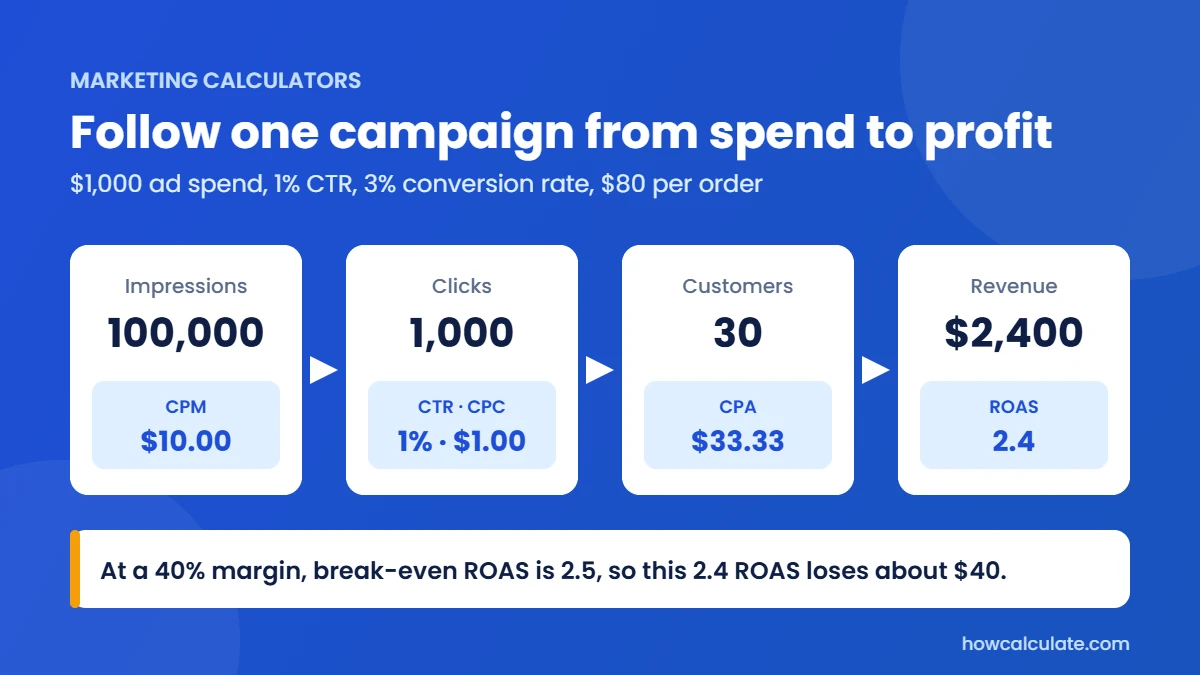
You spend $1,000 and get 100,000 impressions, so your CPM is $10. A 1% CTR gives 1,000 clicks, which makes your CPC $1.00. A 3% conversion rate gives 30 customers, so your CPA is $33.33. If each customer spends $80, you earn $2,400, and your ROAS is 2.4.
Is that good? It depends on your margin. Break-even ROAS is 1 divided by your profit margin. With a 40% margin, break-even is 2.5, so a ROAS of 2.4 loses about $40 on this campaign even though it looks healthy. That’s why the numbers are worth following through the whole chain, not judging one in isolation.
Which metric answers which question?
- “What does reach cost me?” Look at CPM.
- “Is my ad interesting enough to click?” Look at CTR.
- “What does a visit cost?” Look at CPC.
- “What does a customer cost?” Look at CPA and CAC.
- “Am I making money?” Look at ROAS, against your break-even ROAS.
Common mistakes with ad metrics
- Judging a campaign by a single number, such as a low CPM, without checking what follows it.
- Comparing platforms without comparing click-through and conversion rates.
- Forgetting margin, so a healthy-looking ROAS still loses money.
- Mixing date ranges or currencies across reports.
Guides that go deeper
- Average CPM by Platform: what Meta, TikTok, YouTube and others charge.
- What Is a Good CTR?: real numbers for Meta, Google, YouTube and TikTok.
- How to Calculate CPA: the formula, examples and benchmarks.
- What Is a Good ROAS?: benchmarks by platform and industry.
- CAC Formula: Why Your Number Is Probably Too Low: the costs most people leave out.
How do I keep these calculators accurate?
Every calculator is tested against examples I’ve worked out by hand, and benchmarks come from named sources with the date I checked them. You can read more on the How We Calculate page.
Frequently asked questions
What is a marketing calculator?
A marketing calculator turns the numbers from your ad account into the metrics that show whether a campaign is working, such as CPM, CTR, CPA, CAC and ROAS. You enter what you spent and what you got, and it does the division and explains the result.
Which marketing metric matters most?
There is no single one. ROAS tells you whether ads paid back, but only your break-even ROAS tells you whether that was profitable, so the two belong together. CPA and CAC then tell you what a sale and a whole customer cost.
Can I use these calculators for Meta, Google and TikTok ads?
Yes. The formulas are the same on every platform. You type in the impressions, clicks, spend and sales from whichever ad account you use.
What is the difference between CPA and CAC?
CPA counts only the ad spend for one conversion. CAC counts all the sales and marketing costs of winning one new customer, including things like tools and agency fees, so it is usually higher.
Is a high ROAS always good?
No. ROAS measures revenue, not profit. A ROAS of 2.4 loses money at a 40% margin, because break-even is 2.5.
What is the difference between CTR and conversion rate?
CTR is the share of impressions that get a click (clicks ÷ impressions). Conversion rate is the share of those clicks that buy or sign up (conversions ÷ clicks). In the worked example above, the CTR is 1% and the conversion rate is 3%.