Venmo Goods and Services vs Friends and Family: Fees Explained
You sell a used camera for $300, and the buyer wants to pay through Venmo. The payment comes through, but you notice that $8.97 is missing.
What happened? The buyer marked the payment as Goods and Services, which means Venmo charged you a seller fee.
This is one of the main differences between Venmo Goods and Services and Friends and Family. One is meant for eligible purchases, while the other is meant for personal payments. The fee you pay depends on how you receive the money.
Here’s how the two options compare, what you’ll actually keep from a sale, and when a Venmo business profile might save you money.
Fees checked against Venmo’s official fee schedule on October 17, 2026. Rates and terms can change.
Venmo Goods and Services vs Friends and Family: What’s the Difference?
The biggest difference is simple: Friends and Family is for personal payments, while Goods and Services is for eligible sales.
Venmo also offers business profiles, which have their own fee structure.
| Feature | Friends and Family | Goods and Services | Business profile |
|---|---|---|---|
| Main purpose | Personal payments | Eligible purchases | Business sales |
| Receiving fee | Generally $0 | 2.99% | 1.9% + $0.10 for standard direct payments |
| Who pays the seller fee? | No receiving fee | Seller | Business owner |
| Purchase Protection | Not available for ordinary personal transfers | Available for eligible purchases | Available for eligible transactions |
| Best suited for | Paying friends back or splitting bills | Eligible individual sales | Regular sellers and businesses |
The business-profile rate shown here applies to standard direct payments and QR code payments. Tap to Pay has a separate fee, so check Venmo’s fee schedule before comparing payment methods.
Purchase Protection also has limits. Choosing Goods and Services does not automatically mean a transaction is covered.
Who pays the Venmo Goods and Services fee?
The seller pays it.
When a buyer sends money to a personal Venmo account and marks the payment as being for goods and services, Venmo charges the seller 2.99% of the payment amount.
For a $300 sale, that works out to $8.97. You receive $291.03 before any additional fees.
The buyer chooses the payment type, but the seller pays the transaction fee. If you’re selling something, it’s worth agreeing on the payment method and price before the buyer sends the money.
How Much Does Venmo Take From a $300 Sale?
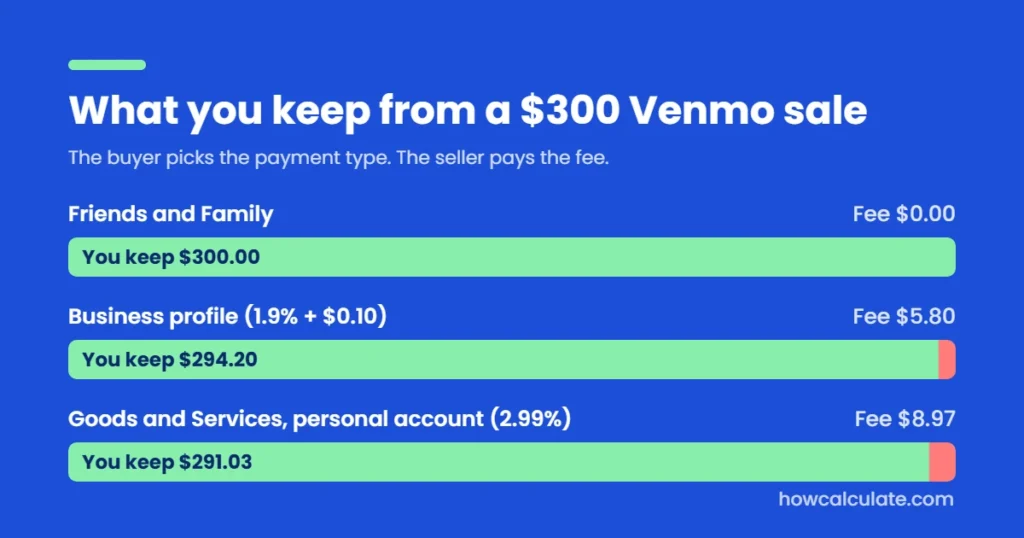
Let’s use the same $300 camera sale to see how much you keep under each option.
| Payment type | Sale amount | Seller fee | You receive |
|---|---|---|---|
| Personal payment | $300.00 | $0.00 | $300.00 |
| Goods and Services to a personal account | $300.00 | $8.97 | $291.03 |
| Standard direct payment to a business profile | $300.00 | $5.80 | $294.20 |
These figures use the fee rates listed above and exclude any other charges or adjustments.
1. Friends and Family
A genuine personal payment generally comes with no receiving fee.
- Amount sent: $300
- Receiving fee: $0
- Amount you receive: $300
That makes it useful for everyday transactions, such as splitting a dinner bill or getting paid back by a friend. It isn’t meant for disguising a sale as a personal payment.
2. Goods and Services
For a payment to a personal account marked as Goods and Services, the seller fee is 2.99%.
The calculation is straightforward:
Seller fee = Payment amount × 2.99%
For a $300 payment: $300 × 0.0299 = $8.97. Subtract the fee, and you’re left with $291.03.
Want to check a different amount? Use our Venmo fee calculator.
3. Business profile
A standard direct payment to a Venmo business profile costs 1.9% + $0.10. On a $300 payment, the fee breaks down like this:
- Percentage fee: $5.70
- Fixed fee: $0.10
- Total fee: $5.80
- Amount you receive: $294.20
That’s $3.17 more than you’d keep from a $300 Goods and Services payment to a personal account.
Why Do Buyers Choose Goods and Services?
For buyers, one reason is Purchase Protection. Eligible purchases may qualify for reimbursement if an item never arrives or arrives damaged, subject to Venmo’s terms.
But there’s an important detail if you’re selling something locally.
An in-person handoff does not automatically qualify for buyer protection. Venmo’s eligibility rules list items that you collect in person as not eligible, except for in-person Venmo QR code transactions.
Seller protection is a separate matter. Certain transactions may qualify if the seller meets Venmo’s requirements and provides the necessary evidence.
So, if someone is buying your camera, agree on how payment and delivery will work before the transaction. Don’t assume that selecting Goods and Services guarantees protection for either party.
You can read the details in Venmo’s Purchase Protection terms and its eligibility rules.
When Should You Use Friends and Family?
Friends and Family makes sense when you’re sending money for personal reasons, such as:
- Splitting a restaurant bill.
- Paying a friend back for concert tickets.
- Sending a birthday gift.
- Reimbursing someone for shared expenses.
Selling a camera, phone, or piece of furniture to a stranger is different. Asking the buyer to mark that payment as Friends and Family just to avoid the fee misrepresents the transaction.
Venmo’s User Agreement explains the rules around receiving payments for goods and services. Depending on the transaction, an authorized Goods and Services payment or a business profile may be appropriate.
The key is to choose the payment method that matches what you’re actually doing.
When Is a Venmo Business Profile Worth It?
If you sell things regularly or accept payments from customers, a business profile may be worth considering.
For standard direct payments, the fee is 1.9% + $0.10. Compare that with the 2.99% fee for Goods and Services payments to a personal account, and the savings become clearer as the sale amount increases.
| Sale amount | Personal-account fee | Business-profile fee | Savings with business profile |
|---|---|---|---|
| $20 | $0.60 | $0.48 | $0.12 |
| $100 | $2.99 | $2.00 | $0.99 |
| $300 | $8.97 | $5.80 | $3.17 |
| $1,000 | $29.90 | $19.10 | $10.80 |
Calculations use 2.99% and 1.9% + $0.10, rounded to cents.
At what amount does the business profile become cheaper?
You can find the break-even point by setting the two fees equal:
2.99% × Sale amount = (1.9% × Sale amount) + $0.10
The result is approximately $9.17.
Above that amount, the standard business-profile fee is lower. Below it, the extra $0.10 makes the business-profile fee slightly higher.
This is only a comparison of transaction fees. Your account eligibility and other business needs still matter. Tap to Pay also has a separate fee, so read Venmo’s business profile information before deciding which payment method to use.
How Much Should You Charge to Keep $300?
If you want to receive $300 after fees, you’ll need to charge a little more.
Goods and Services on a personal account
With a 2.99% fee, the calculation is:
Required payment = Desired amount ÷ (1 − Fee rate)
$300 ÷ (1 − 0.0299) = approximately $309.25. You’d need to charge about $309.25 to keep $300 after the fee.
Standard business-profile payment
For a 1.9% fee plus $0.10:
Required payment = (Desired amount + Fixed fee) ÷ (1 − Percentage rate)
($300 + $0.10) ÷ (1 − 0.019) = approximately $305.91. You’d need to charge about $305.91 to keep $300.
These are estimates based on the stated rates. Actual amounts may differ slightly because fees are rounded to cents.
You can work backward from any target amount using our Venmo fee calculator.
Does Withdrawing Money From Venmo Cost Extra?
It depends on how quickly you need the money. Venmo offers two common transfer options:
- Standard bank transfer: Free. Venmo says it is typically available in 1-3 business days for a linked bank account.
- Instant Transfer: 1.75%, with a $0.25 minimum and a $25 maximum.
Check Venmo’s official fee schedule for the latest rates and eligibility requirements.
Here’s what happens if you instantly transfer the $291.03 left from your camera sale:
- Original sale: $300.00
- Goods and Services fee: −$8.97
- Remaining balance: $291.03
- Instant Transfer fee at 1.75%: −$5.09
- Final amount: $285.94
Your total fees come to $14.06, or about 4.69% of the original sale. If you can wait for a standard bank transfer, you avoid that additional transfer fee and keep $291.03, assuming no other charges or adjustments.
Does the Buyer Pay a Venmo Fee Too?
Usually, the seller’s transaction fee and the buyer’s funding fee are separate.
The seller pays the applicable Goods and Services or business-profile fee. The buyer may also pay a fee depending on how they fund the payment. Venmo’s fee schedule lists a 3% fee for sending money to a Venmo account using a credit card, while sending from a Venmo balance, debit card or bank account is free.
The buyer should check the fee displayed before confirming the payment. That fee is separate from the seller’s transaction fee.
Do You Have to Pay Taxes on Venmo Sales?
Not every payment you receive through Venmo is taxable. What matters is why you received the money and whether the transaction creates taxable income. For example:
- A friend repays you: Reimbursement for a shared expense is generally not income.
- You sell a used item at a loss: Selling a personal item for less than you paid generally doesn’t create a deductible tax loss.
- You sell a personal item at a profit: The profit may be taxable.
- You sell goods or services as a business: Your profits may be taxable under the applicable rules.
What about Form 1099-K?
For third-party payment network transactions, the federal reporting threshold is generally more than $20,000 in gross payments for goods and services and more than 200 transactions in a calendar year. Payment networks may issue Form 1099-K below that threshold, and other reporting rules may apply.
The important distinction is that the reporting threshold is not the same as the threshold for owing tax. You may need to report taxable income even if you don’t receive a Form 1099-K.
For the latest guidance, see the IRS pages on Understanding Your Form 1099-K and Form 1099-K FAQs.
Keep records of your selling prices, original purchase costs, and transaction fees. If you sell regularly or run a business, a qualified tax professional can help you understand your reporting obligations.
Frequently Asked Questions
Is Venmo Goods and Services the same as a business profile?
No. Goods and Services is a payment designation for eligible purchases. A business profile is a separate profile designed for business transactions.
Who pays the Venmo Goods and Services fee?
The seller pays it. Venmo deducts 2.99% from a payment to a personal account when the sender identifies it as being for goods and services.
Can I use Friends and Family to avoid the seller fee?
Not for a genuine sale. Friends and Family is intended for personal payments, not commercial transactions.
Does Goods and Services guarantee buyer protection?
No. Purchase Protection applies only to eligible transactions and items. Items collected in person are generally excluded, except for in-person Venmo QR code transactions.
Is a business profile cheaper than Goods and Services?
For standard direct payments above approximately $9.17, the business profile’s 1.9% + $0.10 fee is lower than the 2.99% personal-account Goods and Services fee.
How much does Venmo charge for a $100 Goods and Services payment?
The fee is $2.99, leaving $97.01 before any additional fees or adjustments.
Is it free to transfer money from Venmo to a bank?
Standard bank transfers are free and typically take 1-3 business days. Instant Transfers have a fee, generally 1.75%, with a $0.25 minimum and a $25 maximum.
Do I have to pay taxes on money received through Venmo?
Not necessarily. Personal reimbursements are generally different from business income or profits from selling items. Tax treatment depends on the transaction, and taxable income may need to be reported even without Form 1099-K.
Which Venmo Payment Type Should You Choose?
It comes down to what the payment is for.
For personal transfers, Friends and Family generally has no receiving fee. For eligible sales, use a payment method that follows Venmo’s rules and account for the seller fee when setting your price. If you sell regularly, compare the business profile’s fees with the amounts you typically receive.
Before accepting payment, check Venmo’s fee schedule, review the applicable Purchase Protection rules, and choose a transfer method that suits your needs.
Want to compare another payment platform? Try our PayPal fee calculator, or see what card payments cost with this guide to Stripe fees. If you sell on a marketplace, the Etsy fee calculator and TikTok Shop fee calculator show what you keep there. You can also browse all our fee calculators, or read How We Calculate to learn about our calculation process.