Break Even ROAS: How to Calculate it the right way?
You spend $1,000 on ads, and your dashboard shows $2,000 in sales. That is a 2x ROAS, and it feels like a win.
Now do the math two ways, using the hoodie example further down. If you only subtract the product cost, you “made” about $267. If you count everything it really cost to deliver those orders, you lost about $81. Same ads, same sales, opposite results.
The difference is your break even ROAS, and most people work it out with the wrong margin. This guide shows how to get it right. If you only want the number, use our break even ROAS calculator. If you want to understand it, keep reading.
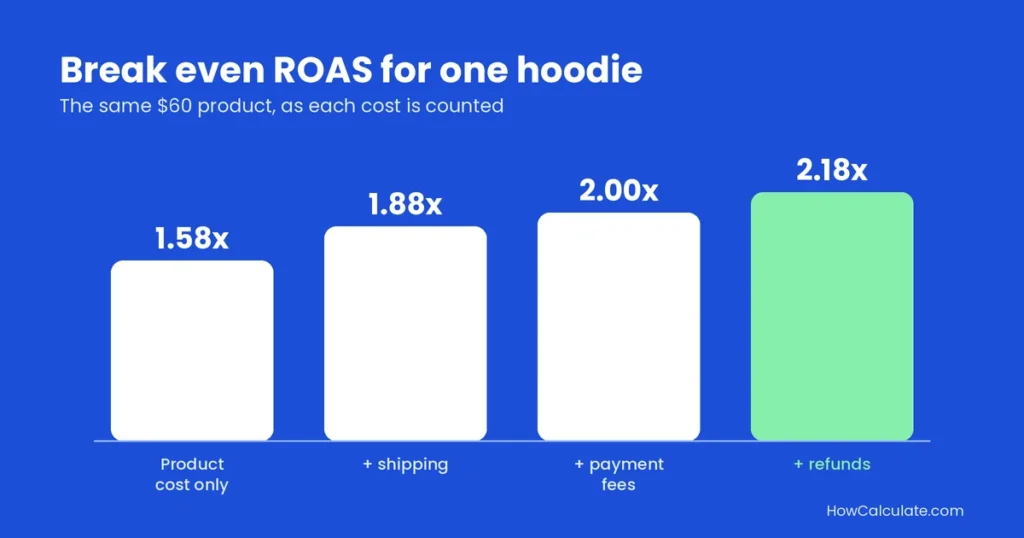
Table of Contents
What break even ROAS tells you
ROAS means return on ad spend. It is the sales your ads bring in for each dollar you spend on them. Our ROAS calculator works it out for any campaign.
Break even ROAS is the lowest ROAS where your ads stop losing money. At that point, the profit from your sales exactly pays for the ads. Above it, your campaign is profitable under your cost assumptions. Below it, your ad spend is more than the profit those sales bring in, even if the dashboard looks healthy.
You may also see it written as BE ROAS, breakeven ROAS or BEROAS. They all mean the same thing.
The break even ROAS formula, and the trap inside it
The formula is short:
Break even ROAS = 1 ÷ margin
Write the margin as a decimal. If you keep 40% of each sale, the margin is 0.40, and 1 ÷ 0.40 = 2.5. You need $2.50 in sales for every $1 of ads just to break even.
The formula is easy. The hard part is knowing which margin to put in.
The right margin is what you keep from each sale after every cost of that order, before you pay for ads. People often use only the product cost. That gives a bigger margin, a smaller break even ROAS, and a false sense of safety.
One hoodie, four break even ROAS numbers
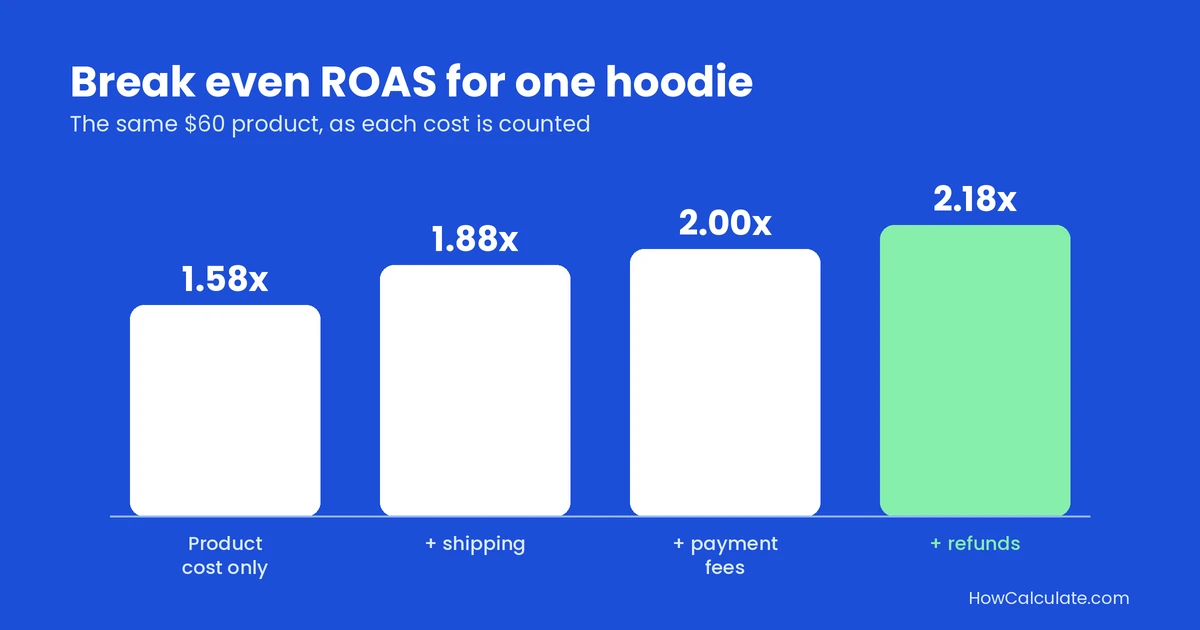
Here is the same product with each cost added one at a time. You sell a hoodie for $60.
- Product cost only ($22): you keep $38, which is a 63% margin. Break even ROAS is 1.58x.
- Add shipping and packaging ($6): you keep $32, a 53% margin. Break even ROAS is 1.88x.
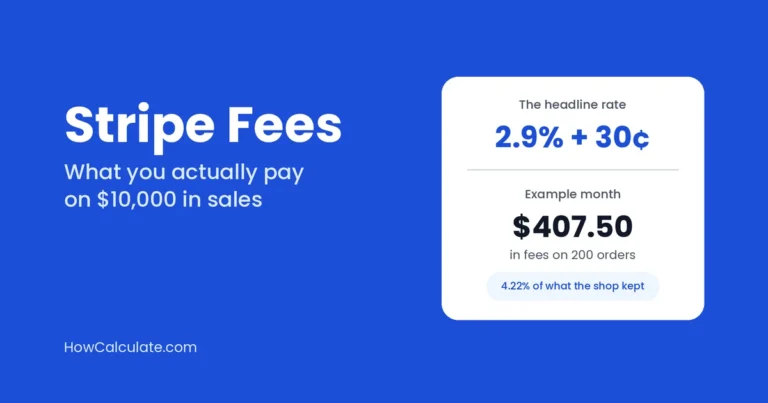
- Add the payment fee: Stripe’s standard US card rate is 2.9% + $0.30, which is $2.04 on a $60 sale. You keep $29.96, a 50% margin. Break even ROAS is 2.00x.
- Add refunds (say 4% of sales, or $2.40): you keep $27.56, a 46% margin. Break even ROAS is 2.18x.
This example assumes the payment fee is not returned when an order is refunded, and that refunded products cannot be resold. If you get fees back or resell returns, your real number will be a little lower.
The true number is 2.18x. The first number, the one most guides teach, is 1.58x. That is about 28% lower than the real break even ROAS (or put the other way, the real number is about 38% higher).
This is where the $81 loss at the start comes from. At a 2x ROAS, you are above 1.58x, so the product-cost math says you are fine. But you are below 2.18x, so you are really losing money on every order.
Here are the costs that people forget most often:
- payment fees, which come out of every sale
- shipping, especially if you offer free shipping
- packaging and pick-and-pack fees from a fulfillment service
- discount codes, which lower the price you actually get
- refunds and returns
What is left of each sale after these order costs, and before ads, is called contribution margin. That is the margin you want. Our Stripe fee calculator can help you find the payment fee if you’re not sure of it.
How to calculate break even ROAS for your own product
You only need three steps.
- Add up every cost of one order. Product, shipping, packaging, payment fee, and an allowance for refunds.
- Subtract that total from the selling price. This is your profit per order before ads. Divide it by the price to get your margin.
- Divide 1 by the margin. The answer is your break even ROAS.
To do this in Excel or Google Sheets, put the price in A2 and your profit per order in B2. Then type =A2/B2 in another cell. It gives the same answer as 1 ÷ margin.
Or skip the steps. Enter your price and costs in the break even ROAS calculator and it does it for you, with a table showing what you’d make or lose at different ROAS levels.
What ROAS do you need for your margin?
Break even ROAS depends only on your margin. The lower your margin, the higher the ROAS you need. Here are some common numbers, and the lowest margin that makes each one work:
- A 1.6x ROAS only works if your margin is above 62.5%.
- A 2x ROAS needs more than 50%.
- A 2.2x ROAS needs more than 45.5%.
- A 3x ROAS needs more than 33.3%.
- A 3.8x ROAS needs more than 26.3%.
- A 4x ROAS needs more than 25%.
- A 7x ROAS needs more than 14.3%.
So when someone asks “is a 3x ROAS good?”, the honest answer is “it depends on your margin”. A 3x ROAS is great at a 60% margin and a loss at a 25% margin. For typical numbers by platform, see our guide to what is a good ROAS. Your own break even number matters more than any benchmark.
Converting ROAS to ACoS
Amazon sellers often use ACoS instead of ROAS. ACoS is ad spend divided by ad sales. It is just ROAS turned upside down:
ACoS = 1 ÷ ROAS, and ROAS = 1 ÷ ACoS
A few quick conversions:
- 10% ACoS is a 10x ROAS
- 20% ACoS is a 5x ROAS
- 25% ACoS is a 4x ROAS
- 50% ACoS is a 2x ROAS
Your break even ACoS is simply your margin. If your margin is 46%, you break even at a 46% ACoS.
Break even ROAS and target ROAS
Break even tells you where you stop losing. You probably want more than that, so you set a profit goal. For example, you might want to keep 15% of every sale.
Target ROAS = 1 ÷ (margin − the profit you want to keep)
With a 46% margin and a 15% profit goal, it is 1 ÷ 0.31 = 3.2x. Your profit goal has to be lower than your margin. If you ask for a bigger profit than the margin allows, no ROAS can get you there.
This is a planning number based on your own profit goal. It is not the same as the Target ROAS bidding setting in Google Ads, which is a tool that tells Google how to bid. You can use your number to help decide what to enter there, but they are two different things.
When break even isn’t the whole story
Break even ROAS is a good floor, but a few things can change how you use it.
First order or lifetime value. The number above uses the profit from one order. If many of your customers buy again, you can accept a lower ROAS on the first order, because later orders add profit. Only do this with real repeat-purchase profit from your own store, not hopes. If you want to work out what a customer costs you across everything you spend, our CAC formula guide explains it.
Platform ROAS and real ROAS. Ad platforms may count sales that would have happened anyway, or count them over a longer period than you do. Check the ROAS in your ad account against the sales you can see in your own store before you trust it.
Fixed costs. Break even ROAS only covers the cost of each order and your ads. It does not cover software, wages or rent. A profit goal above zero is how you plan for those. And if you want to know how much one sale is allowed to cost you, our CPA calculator helps.
FAQ
What ROAS is a 25% ACoS?
A 25% ACoS is a 4x ROAS. Divide 1 by 0.25 to check.
What does 4:1 ROAS mean?
It means you get $4 in sales for every $1 you spend on ads. It is the same as a 4x ROAS. Whether that is good depends on your margin. You need a margin above 25% to make a profit at 4:1.
Is there a break even ROAS formula in Excel?
Yes. If your margin is in cell B2 as a decimal, such as 0.40, type =1/B2. If you have the price and the profit per order instead, type price ÷ profit, such as =A2/B2.
Is break even ROAS the same as the break-even point?
No. The break-even point in general business is the number of units you must sell to cover your fixed costs. Break even ROAS is about ad spend only. It tells you how much revenue each ad dollar needs to bring back.
Does breaking even mean I made a profit?
No. At break even you make zero profit and zero loss on the ads. To make a profit, you need a ROAS above break even.
What is a good break even ROAS?
Lower is better, because it means you need fewer sales for each dollar of ads. A product with a 50% margin breaks even at 2x. A product with a 20% margin needs 5x.