CAC vs CPA: What’s the Difference?
Your ad dashboard says each lead costs $20. Your books say each new customer cost $300. Neither number is wrong. They count different things.
That is the whole story of CAC vs CPA. CPA is what you pay for one action, like a lead or a signup. CAC is what you pay to win one new customer. This guide shows how to work out both and how to move from one to the other. It also covers which one to use for which decision.
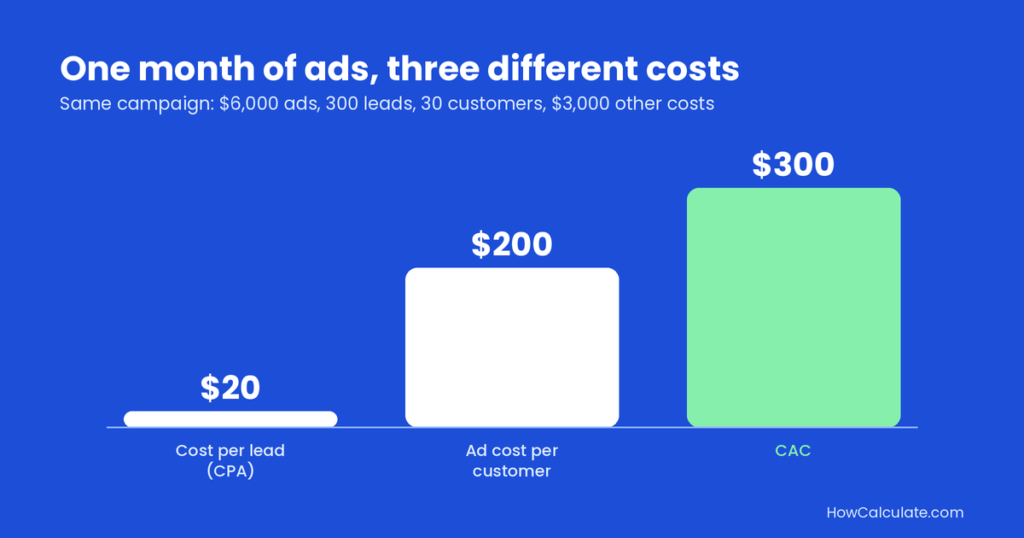
Table of Contents
The short answer
- CPA (cost per acquisition, or cost per action) is your campaign cost divided by the number of actions. The action can be a lead, a signup, a sale, or anything else you track.
- CAC (customer acquisition cost) is what a business spends to win one new customer. It counts the sales and marketing costs the business chooses to include.
CPA tells you how well a campaign works. CAC tells you whether your business can afford to grow. You can work out both with our CPA calculator and CAC calculator.
One month, three different numbers
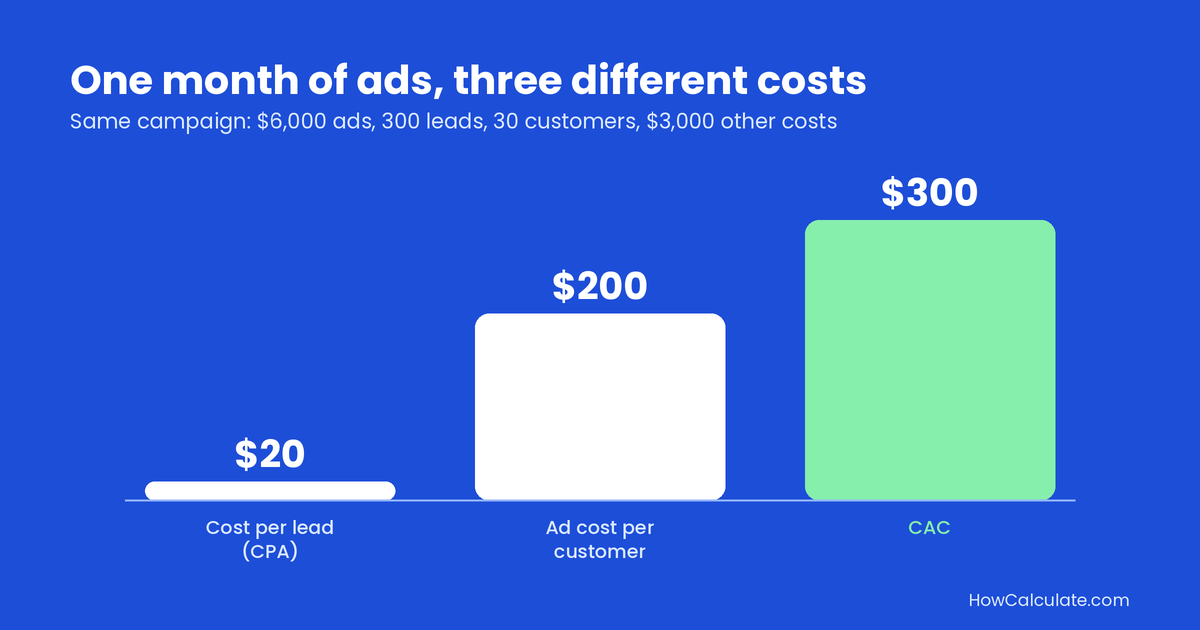
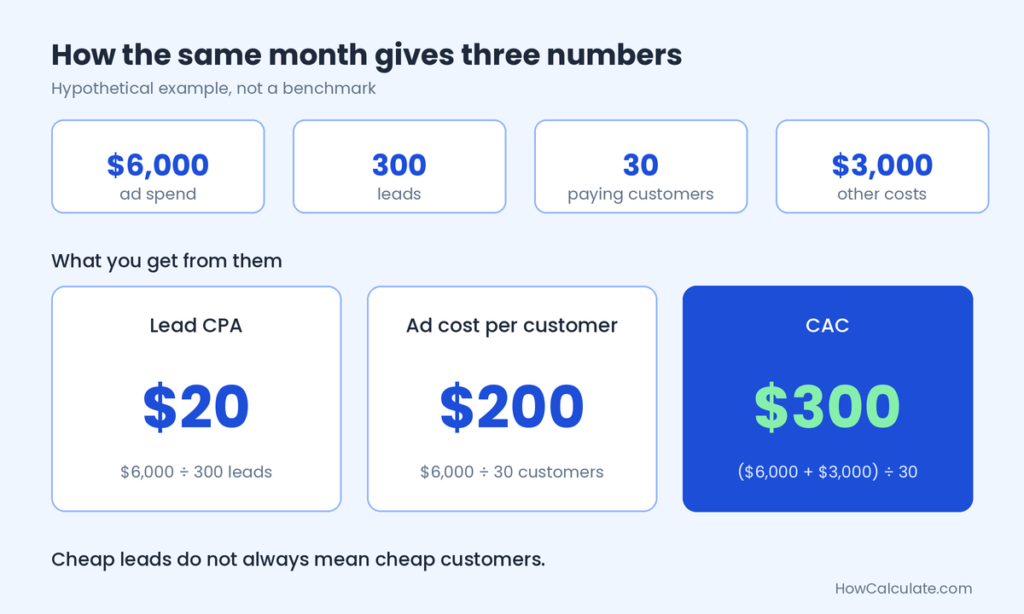
Say a business runs ads for one month. It spends $6,000 on ads and gets 300 leads. Of those leads, 30 become paying customers. It also spends $3,000 on other things to win customers, like sales help, tools and an agency.
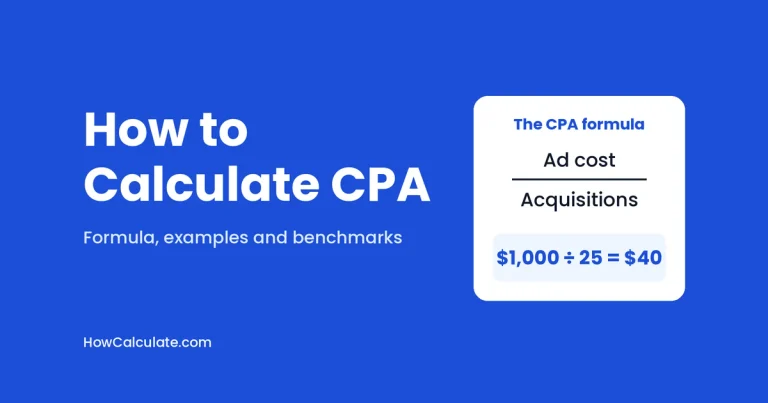
The lead CPA. Divide ad spend by leads: $6,000 ÷ 300 = $20. The ads look cheap.
The ad cost per customer. Only 30 of the 300 leads paid, which is 10%. Divide ad spend by customers: $6,000 ÷ 30 = $200. That is ten times the lead CPA, because only one lead in ten becomes a customer.
The CAC. Add the other costs: $6,000 + $3,000 = $9,000. Divide by customers: $9,000 ÷ 30 = $300.
Three numbers come from the same month: $20, $200 and $300. The lesson is simple. Cheap leads do not always mean cheap customers. (This is a made-up example, not a benchmark.)
How to get from CPA to CAC?
It takes two steps, and each step gives a different number.
Step 1: ad cost per customer. Divide your lead CPA by the share of leads that become customers. $20 ÷ 0.10 = $200.
Step 2: CAC. Add your ad spend and your other acquisition costs, then divide by your new customers:
CAC = (ad spend + other included acquisition costs) ÷ new customers
($6,000 + $3,000) ÷ 30 = $300.
This also shows you where to work. If leads are cheap but few of them buy, don’t just chase an even cheaper lead. Fix what happens after the click, like the landing page, who you target, and how fast you follow up. Moving from 10% to 15% gives you 45 customers from the same 300 leads. The ad cost per customer falls from $200 to $133.33. CAC falls from $300 to $200, because the $3,000 of other costs stays the same. You didn’t change the ads at all.
For the full list of costs you can count in CAC, read our CAC formula guide. For CPA with different kinds of actions, see our guide to calculating CPA.
Which number answers which question
- “Is this ad working?” Look at CPA, and compare only campaigns that track the same action.
- “Are my leads any good?” Look at the ad cost per customer.
- “Can I afford to grow?” Look at CAC, then at how fast customers pay it back.
Why Google Ads shows a different number than your records?
You may see a $25 CPA in Google Ads and a $150 CAC in your own sheet. That doesn’t mean your tracking is broken. The usual reasons are these:
- They count different actions. Google counts the conversion actions you set up, and what it reports depends on your conversion settings and attribution. A conversion can be a form fill, which is not always a paying customer.
- They leave out costs. An ad platform reports your campaign costs and the conversions it credits to them. It usually doesn’t include your wider sales and marketing costs.
- They count returning buyers. Say an ad gets 100 purchases and 30 come from people who already bought before. With $2,000 of spend, the purchase CPA is $20. Assuming the other 70 purchases came from 70 different new customers, the ad cost per new customer is $28.57.
- They use different dates and credit rules. A person may click an ad, come back later from a search, and buy a week after. The platform and your own records may give credit differently.
Before you compare the two numbers, check that they cover the same dates, the same costs and the same kind of customer.
CAC vs CPA: when to use each
Use CPA to manage ads. It helps you compare campaigns, ads and audiences, as long as they all track the same action. A $15 lead CPA is not better than a $40 sale CPA, because they are different steps of the journey. If you set a goal in Google Ads, Target CPA bidding aims for that average cost, but single conversions can cost more or less.
Use CAC to judge the business. Is it worth spending this much to win a customer? Is the cost going up or down? For subscription products, two more ideas help:
- LTV compared with CAC. Customer lifetime value (LTV) is what a customer is worth to you over time. Put it next to CAC to see whether winning customers pays off. Compare like with like, such as profit with profit.
- Payback period. This is how long a customer takes to pay back their CAC. The simple formula is CAC ÷ monthly gross profit per customer. With a $300 CAC and $50 a month in gross profit, payback is 6 months. Stripe explains CAC payback in more detail.
Four ways these numbers go wrong
- Comparing leads with customers. A $20 lead and a $300 customer are not the same thing, so don’t line them up.
- Changing what you count. If you count only ad spend one month and add salaries the next, CAC will jump for no real reason. Pick your costs once and keep them.
- Ignoring timing. A customer who buys in March may have clicked an ad in January. If your sales cycle is long, one month can mislead you.
- Cutting the high-CPA campaign too fast. A campaign with a higher CPA can bring customers who spend more and stay longer. Check customer value before you cut it.
Track both in one sheet
You don’t need special software. Make a spreadsheet with one row per month. Put the ad spend in column B, the leads in C, the other acquisition costs in D, and the new customers in E. Then use these formulas in row 2:
- Lead CPA:
=B2/C2 - Ad cost per customer:
=B2/E2 - CAC:
=(B2+D2)/E2
Copy them down each month. After a few months you can see which number is moving and why.
What is a good CAC or CPA?
There is no number that is good for everyone. It depends on your profit per sale, how long customers stay, and how fast you need your money back. If you sell a product with thin margins, check your break-even point first. Our guide to break-even ROAS shows how, and our ROAS calculator does the sum for you.
A simple check: if the gross profit a customer brings in over the period you measure is lower than your CAC, you may not earn back what it cost to win them.
Frequently asked questions
Is CAC the same as CPA?
No, not always. CAC is the cost of one new paying customer, with the acquisition costs you chose to include. CPA is the cost of one tracked action. They match only when the costs, the actions and the dates are the same.
Can CAC and CPA be equal?
Yes. If you spend $5,000 and win 25 new customers, and both numbers use that same $5,000 and those same 25 customers, each one is $200.
Why is CAC usually higher than CPA?
CAC often includes more costs, like salaries and tools, and it counts customers instead of leads. But it is not always higher. It depends on what you count.
What is the difference between CPA and cost per lead?
Cost per lead (CPL) is the cost of one lead. CPA is the cost of any tracked action. If the action is a lead form, then CPA and CPL are the same number.
How do you calculate CAC from CPA?
First divide your lead CPA by the share of leads that become customers. For example, $20 ÷ 0.10 = $200 per customer. Then add your other acquisition costs to your ad spend and divide the total by your new customers.
What is a good CAC?
It is a CAC your business can afford. Compare it with the gross profit a customer brings and how fast you get your money back, instead of using a fixed number.
Final word
Track CPA to see how your campaigns are doing. Track CAC to see whether your business can afford to grow. When the two don’t match, the cause is almost always the costs or the actions being counted, not a mistake.