
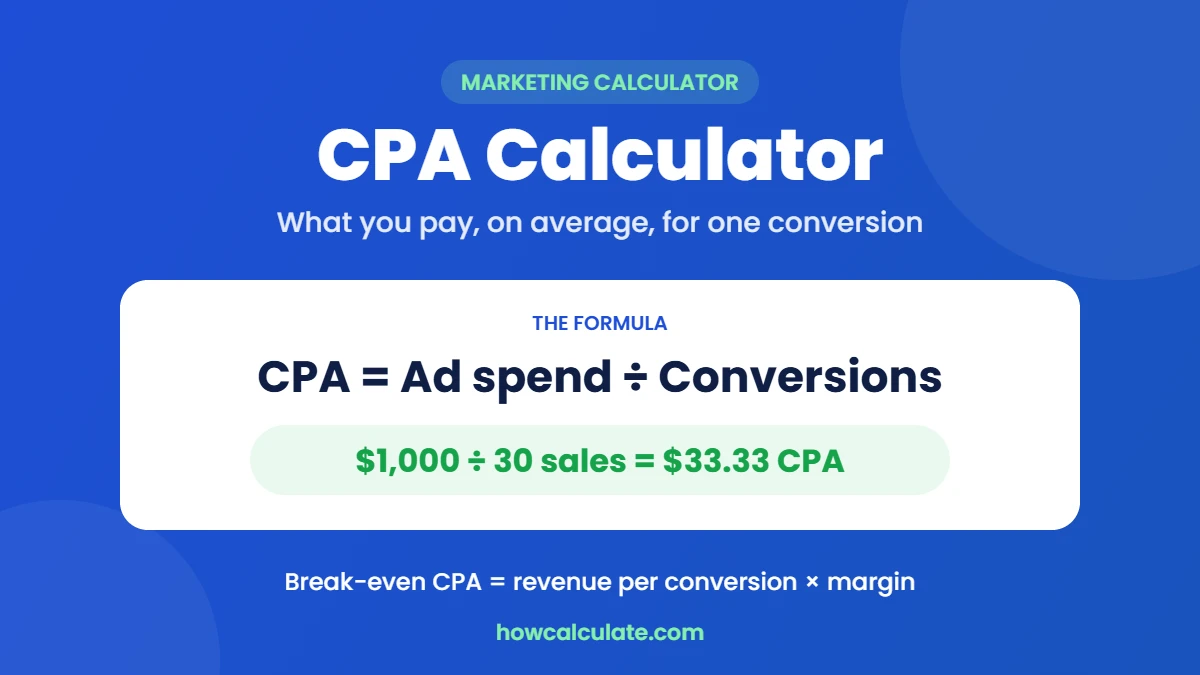
CPA (cost per acquisition) is how much you pay, on average, to get one conversion from your ads. The formula is CPA = ad spend ÷ conversions. If you spend $1,000 and get 30 customers, your CPA is $33.33. The CPA calculator above works that out for you. It can also find the budget you need for a number of conversions, and your break-even CPA, which is the most you can pay for a conversion and still not lose money.
By Ajay Kumar, SEO strategist and content writer. Last updated: November 12, 2026
How do you use the CPA calculator?
- Choose what you want to find: your CPA, how many conversions a budget gets you, the budget you need, or your break-even CPA.
- Fill in the boxes that show up. For a plain CPA, that’s just your ad spend and your number of conversions.
- Add revenue per conversion and your margin if you know them. They’re optional, but they tell you whether each conversion makes or loses money.
- Hit Calculate. You get your CPA, and a break-even check if you filled in the extra boxes.
In short
- CPA = ad spend ÷ conversions.
- A conversion is whatever action you count: a sale, a signup, a lead, an app install.
- CPA only means something next to what a conversion is worth. A $50 CPA is great for a $500 sale and terrible for a $20 one.
- Your break-even CPA is revenue per conversion × your margin before ad spend.
- Lower isn’t always better. Cheap conversions that don’t turn into revenue are not a win.
What is CPA?
CPA stands for cost per acquisition. Some people say cost per action, because the “acquisition” can be anything you’ve decided counts as a conversion. It might be a purchase, a form fill, a free trial or a phone call.
CPA answers the question every advertiser eventually asks: what does one result cost me? It’s easier to act on than clicks or impressions, because it ties your spend to something that matters to the business.
How to calculate CPA
Divide your total ad spend by the number of conversions it produced.
- CPA = ad spend ÷ conversions
- Conversions = ad spend ÷ CPA
- Budget needed = target CPA × conversions wanted
- Break-even CPA = revenue per conversion × margin before ad spend (as a decimal)
- Profit per conversion = break-even CPA − actual CPA
For a longer walkthrough with more examples, read our guide on how to calculate CPA.
Here are the steps:
- Find your ad spend for a set period.
- Find the number of conversions in the same period.
- Divide spend by conversions.
In a spreadsheet, put spend in A2 and conversions in B2, then type =A2/B2.
Use the same dates and the same conversion definition for both numbers. If your ad platform counts “leads” and your CRM counts “customers,” those are two different CPAs.
How to calculate CPA in Google Ads and Meta ads
You don’t always have to work it out by hand. Both platforms show it, they just call it something else:
- Google Ads: look for the Cost / conv. column. It’s your cost divided by your conversions, which is CPA.
- Meta ads (Facebook and Instagram): look for Cost per result. The “result” is whatever goal you picked for the campaign, like a purchase or a lead.
Cost per conversion, cost per action and cost per acquisition all use the same math: spend ÷ conversions. The names change, but the formula doesn’t. What really matters is what you count as a conversion. If Google counts add-to-carts and you only care about purchases, add a column for purchases and work out the CPA on that instead.
Working it out yourself still helps when you’re comparing platforms, checking an agency’s report, or adding up CPA across several campaigns. For a combined CPA, add up all the spend and divide it by all the conversions. Don’t average the CPAs.
CPA examples
Example 1: Find the CPA
You spent $1,000 and got 30 conversions. CPA = 1,000 ÷ 30 = $33.33.
Example 2: Find the conversions
You have $3,000 to spend and your target CPA is $25. Conversions = 3,000 ÷ 25 = 120.
Example 3: Find the budget
You want 150 conversions at a $40 CPA. Budget = 40 × 150 = $6,000.
Example 4: Find the break-even CPA
Each conversion is an order worth $80, and your margin before ad spend is 40%. Break-even CPA = 80 × 0.40 = $32. That’s the most you can pay for an order before the ads cost more than the order earns.
Example 5: Check the profit
Back to Example 1. You paid $33.33 per conversion, and your break-even CPA is $32. Your profit per conversion is 32 − 33.33 = −$1.33. Over 30 conversions, that’s about −$40. The ads look fine, but they lose a little money on every order.
Example 6: a better result
You spend $600 and get 30 conversions from the same $80 orders. CPA = 600 ÷ 30 = $20. Profit per conversion = 32 − 20 = $12, or $360 across all 30.
CPA and break-even: the number that matters
Most people look at CPA by itself. The better move is to compare it with your break-even CPA.
Break-even CPA is the revenue a conversion brings in, multiplied by the share you keep after product cost, shipping and fees, but before ad spend. If you pay less than that, the ad makes money. If you pay more, it loses money.
It’s the same idea as break-even ROAS, seen from the other side. At an $80 order and a 40% margin, break-even CPA is $32, and break-even ROAS is 2.5. At a $32 CPA, you earn $80 for every $32 spent, which is a ROAS of 2.5. You can try the ROAS calculator to see the match.
Quick answers: what common CPAs work out to
- $500 spent, 25 sales: CPA is $20.
- $2,000 spent, 40 leads: CPA (your cost per lead) is $50.
- $1,500 spent, 10 sales: CPA is $150.
- $50 orders at a 30% margin: break-even CPA is $15. Pay more than that and each sale loses money.
- $100 orders and a target ROAS of 4: you can pay up to $25 per sale.
- $1,000 budget at a $40 target CPA: expect about 25 conversions.
What is a good CPA?
There is no single good CPA. It depends on what a conversion is worth, on your margin and on your industry. Benchmarks help you check you’re in the right range, but your own break-even CPA is the number that matters most.
Here are some recent figures, which come from different datasets and don’t match exactly:
| Source and channel | Typical CPA |
|---|---|
| Meta ads, ecommerce brands (Triple Whale, Aug 2025 to Jul 2026) | median $38.99, up 3.1% from the year before |
| Google Ads, ecommerce brands (Triple Whale, same period) | median $28.14, up 10.0% from the year before |
| Google Ads, 25 industries (Two Minute Reports) | median CPA from $3.62 to $59.07 by industry |
Triple Whale’s data comes from ecommerce brands, while Two Minute Reports covers 25 industries, so the ranges differ. See the full tables in Triple Whale’s reports for Meta ads and Google Ads, and Two Minute Reports’ Google Ads benchmarks for 25 industries.
Last verified: November 2026
CPA keeps rising. Triple Whale reported that median CPA increased year over year on both Meta and Google in its latest data, so a number that looked normal a couple of years ago may be too low to hit today.
CPA vs CAC vs CPL
These three get mixed up.
| What it measures | What’s included | |
|---|---|---|
| CPA | cost per conversion | usually just ad spend |
| CAC | cost to win one new customer | all sales and marketing costs |
| CPL | cost per lead | ad spend divided by leads |
CPA is a campaign number. CAC is a business number that includes salaries, tools, and agency fees. If your conversion is a lead, your CPA is the same as your CPL. And if only some leads become customers, your cost per customer will be higher.
Want the full comparison? See CAC vs CPA.
CPA and the rest of your ad numbers
CPA is the result of everything before it:
- You pay for impressions at a price called CPM.
- Some people click. That’s your CTR.
- You pay for each click. That’s your cost per click.
- Some clicks convert. That’s your conversion rate.
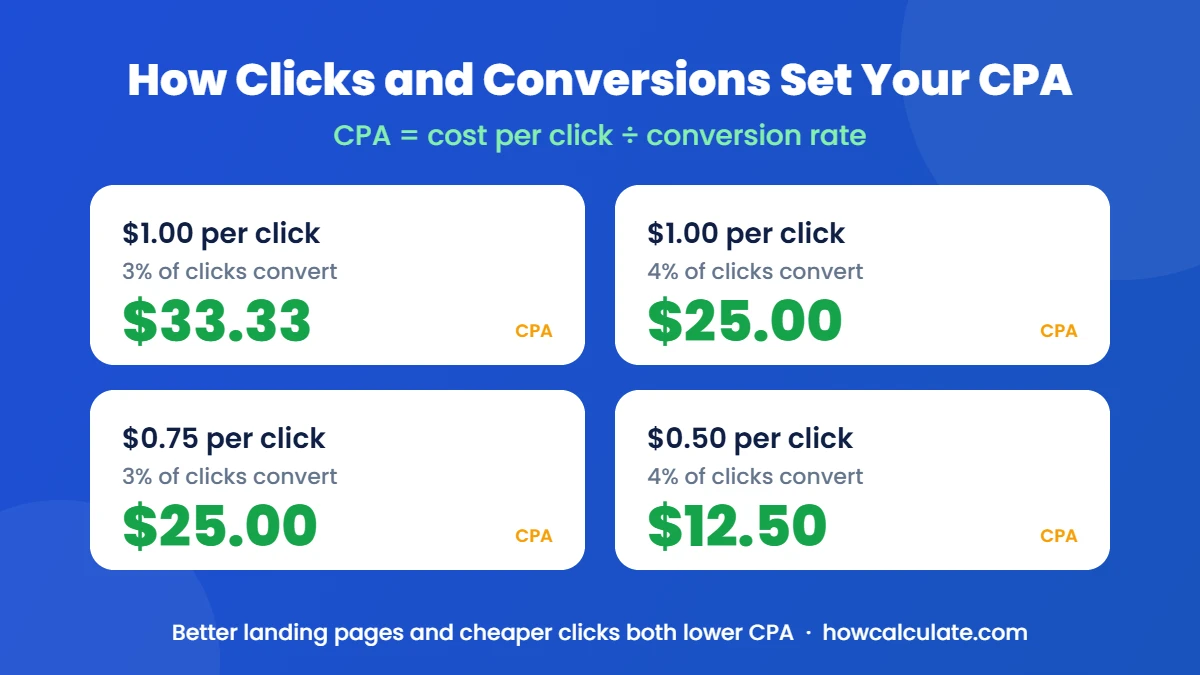
Put together: CPA = cost per click ÷ conversion rate. If you pay $1.00 per click and 3% of clicks convert, your CPA is 1.00 ÷ 0.03 = $33.33. Raise the conversion rate to 4% and the CPA falls to $25. Cut the cost per click to $0.75 at 3%, and it also falls to $25.
How to lower your CPA
- Improve the landing page. A clearer offer and a simpler page turn more clicks into conversions.
- Raise your CTR. More clicks from the same impressions bring the cost per click down.
- Target better. Stop paying to reach people who never convert.
- Test new ads and offers. One change at a time.
- Pause what isn’t working. Look at CPA by campaign, ad group and audience, and cut the worst.
- Raise what a conversion is worth. Higher order values give you more room, which raises your break-even CPA.
One caution: pushing CPA down too hard can starve a campaign of volume. Sometimes a slightly higher CPA with far more conversions means more total profit.
Common CPA mistakes
- Judging CPA without knowing break-even CPA.
- Using different date ranges or different conversion definitions for spend and conversions.
- Counting every lead as a customer.
- Comparing CPAs across channels without checking the quality of conversions.
- Ignoring returns and refunds.
- Chasing the lowest CPA instead of the most total profit.
CPA calculator FAQ
How do you calculate CPA?
Divide ad spend by conversions. For $1,000 and 30 conversions, CPA = 1,000 ÷ 30 = $33.33.
What is a good CPA?
It depends on what a conversion is worth. A good CPA is below your break-even CPA, which is revenue per conversion times your margin before ad spend. Benchmarks vary widely by industry and channel.
What is break-even CPA?
It’s the most you can pay for a conversion without losing money. With an $80 order and a 40% margin, it’s 80 × 0.40 = $32.
What is the difference between CPA and CAC?
CPA usually counts only ad spend per conversion. CAC counts all sales and marketing costs to win a new customer.
Is CPA the same as cost per lead?
If your conversion is a lead, yes. CPL is just CPA when the conversion is a lead.
How does CPA relate to ROAS?
They’re two views of the same thing. ROAS is revenue per ad dollar, and CPA is ad cost per conversion. If you know the revenue per conversion, ROAS = revenue per conversion ÷ CPA.
How can I lower my CPA?
Improve your landing page and conversion rate, raise your CTR, target better audiences, test new ads and pause weak campaigns.
Is cost per conversion the same as CPA?
Yes. Cost per conversion is just another name for CPA. Google Ads shows it as Cost / conv., and the formula is the same: ad spend ÷ conversions.
Who should use a CPA calculator?
Anyone who runs ads and counts results: online store owners, lead-gen businesses, app marketers, and freelancers or agencies reporting to clients. If you know what you spent and how many conversions you got, you can use it.
How this calculator works
The calculator uses standard definitions and runs entirely in your browser, so nothing you type is sent anywhere. I test every result against hand-calculated examples. See How We Calculate for how I test and update the tools. Results are estimates based on the numbers you enter. They aren’t financial advice.