Average TikTok Shop Affiliate Commission: What Rate Should Sellers Offer?
Set your commission at 5% and most creators will scroll right past your product. Set it at 30% and you may be paying them to sell at a loss. The right rate sits somewhere in between, and it’s different for every product.
This guide is for sellers deciding what to offer creators on TikTok Shop. It covers what other sellers pay, the limits TikTok sets, and a simple way to find the highest rate your own product can afford.
Last updated: October 21, 2026. Platform rules checked against TikTok’s Seller Center help pages and affiliate commission guide.
What is the average TikTok Shop affiliate commission?
Most US TikTok Shop sellers offer creators between 10% and 20% of each sale, and about 15% is a common middle point. TikTok doesn’t publish an official average. Beauty and health products usually pay more, often 15–20%, while electronics usually pay less, around 8–12%.
Those numbers come from agencies that run creator programs for many brands, not from TikTok. The closest thing to an official benchmark is the recommended rate TikTok shows you inside Affiliate Center, which is based on what similar products in your category are paying right now.
What commission rates does TikTok Shop allow?
TikTok lets sellers set any affiliate commission from 1% to 80% of the order. The same range applies to open collaborations and target collaborations, and you set it product by product.
Inside Affiliate Center, TikTok can also suggest an “optimized” rate. According to its open collaboration help page, this is based on the top-performing 30% of products in your shop and across the product marketplace. Check that number before you choose. It reflects live data, which no outside guide can match.
Typical TikTok Shop affiliate commission rates by category (2026)
Commission rates on TikTok Shop vary mostly by category, because margins and competition for creators vary. The most useful public data comes from agencies that run creator programs for many brands. Here’s how two of them compare for 2026:
| Category | Z Media (300+ brands, H1 2026) | Hubfluence (2026 programs) |
|---|---|---|
| Beauty | 15–20% | 15–25% |
| Health and wellness | 15–20% | 20–30% |
| Fashion and apparel | 12–18% | 10–15% |
| Home and living | 10–15% | 10–20% |
| Food and beverage | 10–15% | 10–20% |
| Electronics | 8–12% | 5–15% |
| Pet supplies | 12–18% | — |
| Baby and kids | 12–16% | — |
The two sources don’t match exactly, but they point the same way: beauty and health pay the most, and electronics pay the least. Z Media‘s ranges cover the middle 80% of the brands it works with. Hubfluence describes its numbers as the ranges it sees across active TikTok Shop US programs.
Treat these as a reference point, not a target. A category average tells you what other sellers pay. It doesn’t tell you what your product can afford.
How much commission can your product afford?
The most you can safely offer equals your profit before the creator gets paid, minus the profit you want to keep, divided by your price. Work it out in two steps:
1. Profit before creator = price − product cost − shipping label − TikTok’s fee
2. Maximum commission = (profit before creator − profit you want to keep) ÷ price
Here’s the math on three different products. Each one pays TikTok’s 6% referral fee, which we explain in our guide to how much TikTok Shop takes from sellers. The product and shipping costs are examples:
A $12 phone accessory
- Product cost $4, shipping label $5, TikTok fee $0.72
- Profit before creator: $2.28
- To keep at least $1 per sale, the most you can offer is about 10%
- At a typical 15%, the creator gets $1.80 and you keep just $0.48
A $25 skincare item
- Product cost $8, shipping label $5, TikTok fee $1.50
- Profit before creator: $10.50
- To keep at least $5 per sale, the most you can offer is 22%
- At 15%, the creator gets $3.75 and you keep $6.75
A $60 home product
- Product cost $18, shipping label $7, TikTok fee $3.60
- Profit before creator: $31.40
- To keep at least $15 per sale, the most you can offer is about 27%
- At 15%, the creator gets $9 and you keep $22.40
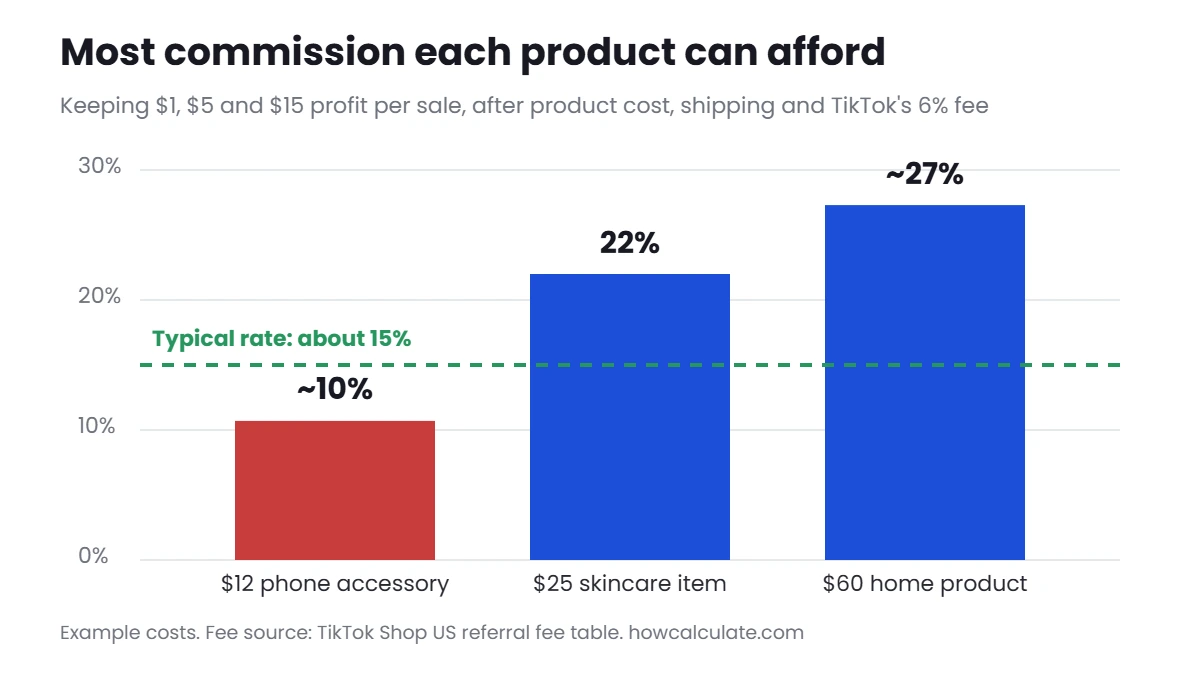
The $12 item can’t afford the commission most creators expect. That’s the real problem with cheap products on TikTok Shop, and no commission setting fixes it. Raise the price, sell it in a bundle, or skip affiliates for that product.
To test your own numbers, enter your price, costs and creator rate into our TikTok Shop fee calculator. It shows what you keep per order at any commission rate.
Open vs Target collaboration: Which pays creators more?
In a target collaboration, you invite specific creators and can give them their own rate, so sellers often pay more there than in open collaborations. In an open collaboration, you set one rate and any eligible creator can promote the product. One agency guide from MADA puts typical open collaboration rates at around 10–15% and target collaboration rates at 15–25%, though it doesn’t share its full method.
Before you change any rate, know how TikTok handles it:
- Raising a rate takes effect right away for creators already promoting your product.
- Lowering a rate is delayed. Under TikTok’s commission protection rules, creators already promoting the product keep their old rate for 30 days. In an open collaboration, a new rate takes effect 30 days after your edit. In a target collaboration, it’s 5 days.
- Carousel posts pay less by default. TikTok sets the commission on shoppable photo carousels at 60% of your video rate. You can change it.
- Ad-driven sales can have their own rate. If you run ads using a creator’s post, you can set a separate Shop Ads commission rate, also between 1% and 80%. Without one, the creator earns your standard rate on those sales too.
Because a cut takes weeks to apply, it’s smarter to start at a rate you can live with than to start high and lower it later.
Two other ways to pay creators: tiers and flat fees
You don’t have to use one fixed percentage for everything. TikTok offers two other options:
- Tiered commissions. In an open collaboration, you can pay a different rate once a creator reaches a set number of orders. TikTok’s own example is 10% on the first 100 orders and 15% after that. Right now you can set up to two tiers, and once the tiers are live, you can’t change the order threshold, and the rates can only go up. See TikTok’s tiered commissions guide.
- Flat-fee collaborations. A type of target collaboration where you pay a creator an upfront fee, from $20 to $10,000 per creator, for one shoppable video. You can add a sales commission on top. You can invite up to 50 creators at a time and ask for up to three rounds of edits before the video goes live. See TikTok’s flat fee collaboration guide.
Tiers work well when you want to reward creators who actually sell. Flat fees make more sense when you want a specific creator’s content and are happy to pay for it, whether it sells or not.
How is TikTok Shop affiliate commission calculated?
TikTok calculates affiliate commission as (revenue − refunds) × commission rate. In plain words, the creator earns their rate on what the buyer actually paid for the item. That formula comes straight from TikTok’s affiliate commission guide.
- No refund: the creator gets the full commission.
- Partial refund: the commission is worked out on the amount left after the refund.
- Full refund: the commission drops to zero.
Commission is paid only after the order settles. TikTok says creators typically receive it about 15 days after delivery, but if the seller’s shop is on a slower settlement schedule, such as delivery plus 31 days, the creator waits that long too.
How much do TikTok Shop affiliates earn per sale?
A TikTok Shop affiliate earns the seller’s commission rate on each item they sell, not a fixed amount per view. If a creator sells a $25 product at 15% commission, they earn $3.75 once the order settles. Ten sales of that product earn them $37.50.
This is where many people get confused. Views on their own don’t earn shop commission. Payouts based on views come from a separate program, TikTok’s Creator Rewards Program, which has its own eligibility rules. On TikTok Shop, a video with a million views and no sales earns no commission.
For sellers, that’s the good news: you only pay creators when they actually sell something.
How do you track creator commissions on TikTok Shop?
You can track creator commissions inside Seller Center, without any outside tool. TikTok gives you a few places to check:
- Commission history: in both Open Collab and Target Collab, you can search a creator by handle and see each commission edit, the active rate and the dates it applied.
- Estimated commission: the Finances section shows an “Est. Standard commission payment” on unsettled orders. According to TikTok’s Finances FAQ, this is an estimate and can change if an order is returned or refunded.
- Affiliate vs self-sold sales: your sales data can be filtered to show affiliate sales separately from sales you make through your own account.
If you also run ads, track your ad spend next to commission. Our break-even ROAS calculator shows how much ad spend a product can take before it stops making money.
Common commission mistakes sellers make
- Copying the category average without checking margin. A 15% rate is normal for beauty, but a cheap beauty product may not be able to afford it.
- Forgetting the other costs. Commission comes on top of TikTok’s 6% fee, your shipping label and returns, not instead of them.
- Starting too high to attract creators. Creators already promoting your product keep the higher rate for 30 days after you lower it.
- Ignoring free samples. TikTok lets you offer free samples in both open and target collaborations. For many creators, a sample matters as much as an extra few percent.
- Paying full commission on ad sales. If you run ads on creator posts, set a separate Shop Ads rate so you’re not paying full commission on top of your ad spend.
TikTok Shop affiliate commission FAQs
What is a good commission rate for TikTok Shop?
A good rate is close to your category’s normal range and still leaves you a profit after product cost, shipping and TikTok’s fee. For many products, that’s somewhere between 12% and 20%.
What are TikTok Shop affiliate commission rates in 2026?
Most US sellers offer 10–20%. Agency data from 2026 puts beauty and health at about 15–20%, fashion at 12–18%, home and food at 10–15%, and electronics at 8–12%. TikTok allows anything from 1% to 80%.
Who pays the affiliate commission on TikTok Shop?
The seller pays it. It’s deducted from your payout when a creator’s sale settles.
Is affiliate commission the same as TikTok’s referral fee?
No. The referral fee, 6% for most categories, goes to TikTok on every sale. Affiliate commission goes to the creator, and only on sales they bring in. Our TikTok Shop fee guide covers the referral fee in detail.
Can I change my TikTok Shop commission rate later?
Yes. Increases apply right away. Decreases only reach creators already promoting the product after a 30-day protection period, and new rates in open collaborations take effect 30 days after the edit.
Do creators get commission on refunded orders?
No. A full refund brings the commission to zero, and a partial refund lowers it to match what the buyer kept.
What is a tiered commission on TikTok Shop?
It’s a way to pay creators a different rate based on how many orders they bring in. For example, 10% on the first 100 orders and 15% after that. TikTok allows up to two tiers in open collaborations, and once set, the rates can only be increased.
Is being a TikTok Shop affiliate worth it for creators?
It can be, if a creator’s audience actually buys. Earnings depend on sales, not views, so a creator whose audience trusts their picks in one niche can earn more than one with a bigger but broader following.
Choosing your commission rate
Start with the recommended rate in Affiliate Center, check it against your category’s typical range, then make sure your margin can cover it. Pick the highest rate that still leaves you a profit you’re happy with, and leave yourself room to raise it later.
To see what you’d keep at different rates, try our free TikTok Shop fee calculator. Still deciding whether to sell on TikTok at all? Read Is TikTok Shop worth it?