How to Advertise an Etsy Shop: 10 Ways to Get Sales
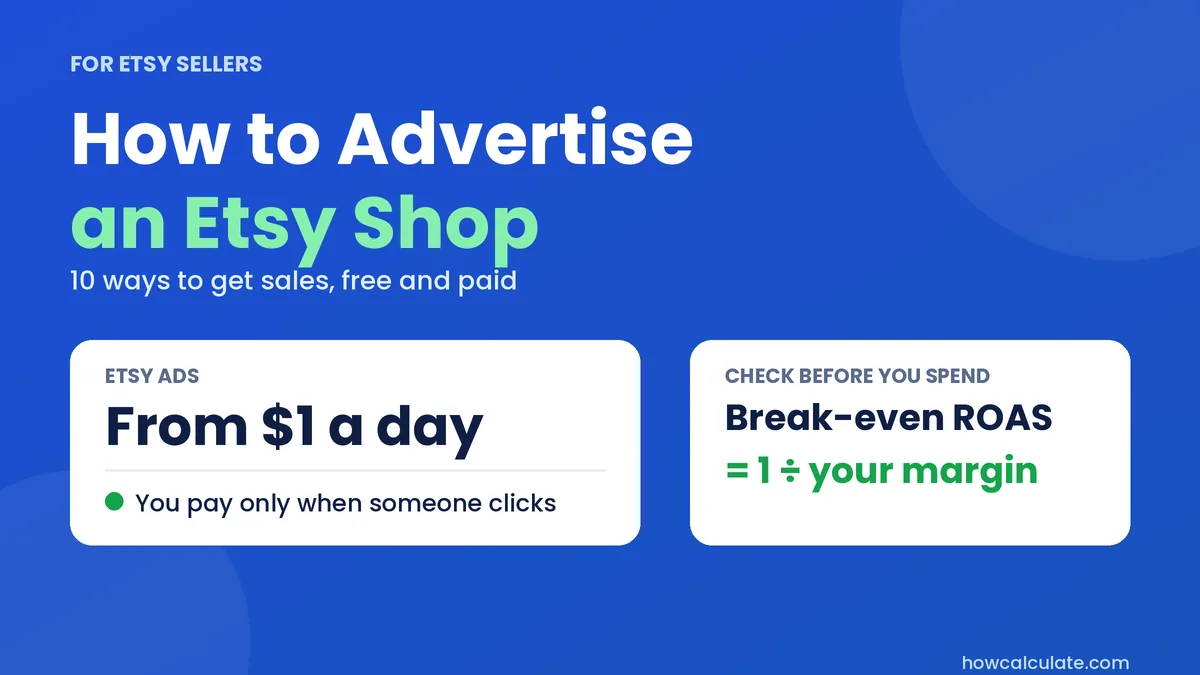
You can advertise an Etsy shop for free with better listings, Etsy search, Pinterest and social media, or pay for Etsy Ads, which start at $1 a day and only charge you when someone clicks. For most new sellers, free methods first and a small Etsy Ads test second is the safest order.
Rules and fees last verified November 10, 2026, against Etsy’s Etsy Ads and Offsite Ads help pages. Checked by Ajay Kumar.
Before you spend anything, do a little math.
Say you put $5 a day into Etsy Ads. That’s about $150 a month. If you keep $20 from each sale after costs but before ads, you need about 8 sales from those ads just to get your $150 back. Sales beyond that are profit. Fewer than that is a loss.
That’s why this guide doesn’t only list places to promote. Here’s how to advertise an Etsy shop in ten ways, roughly in the order I’d try them, followed by a simple way to check whether the paid ones are working.
1. Fix your listings before you promote anything
Every ad, pin and post ends in the same place: your listing. If it’s weak, the visitor leaves. Etsy says the same thing in its own help page: ads work best when listings already get interest, and they’re unlikely to turn a low-demand listing into a top seller.
Check these first:
- Photos: Clear pictures from a few angles, plus one showing the item in use.
- Title: Say exactly what the item is, in the words a buyer would type.
- Description: Materials, size, color options and anything you can personalize.
- Shipping: Processing time, delivery estimate and cost, easy to find.
- Price: Leave room for Etsy’s fees, shipping and your ad costs.
Price is the one many sellers skip. If your price has no room for fees and ads, advertising only makes the problem bigger. Our Etsy fee calculator shows what’s left from a sale, and the guide on how much Etsy takes per sale explains each fee.
2. Get found in Etsy search
Most Etsy shoppers start with a search, so your titles and tags are free advertising. Etsy gives you up to 13 tags per listing. Use phrases a buyer would really type, and fill in the attributes Etsy asks for, like color, size, and occasion.
If you sell leather wallets, “personalized leather wallet” and “minimalist wallet for men” will do more than “nice wallet.” Don’t repeat the same words in every tag. Spread them across different searches.
Keep in mind that Etsy search and Google are different. Doing well in one doesn’t promise rankings in the other.
3. Test Etsy Ads with a small budget
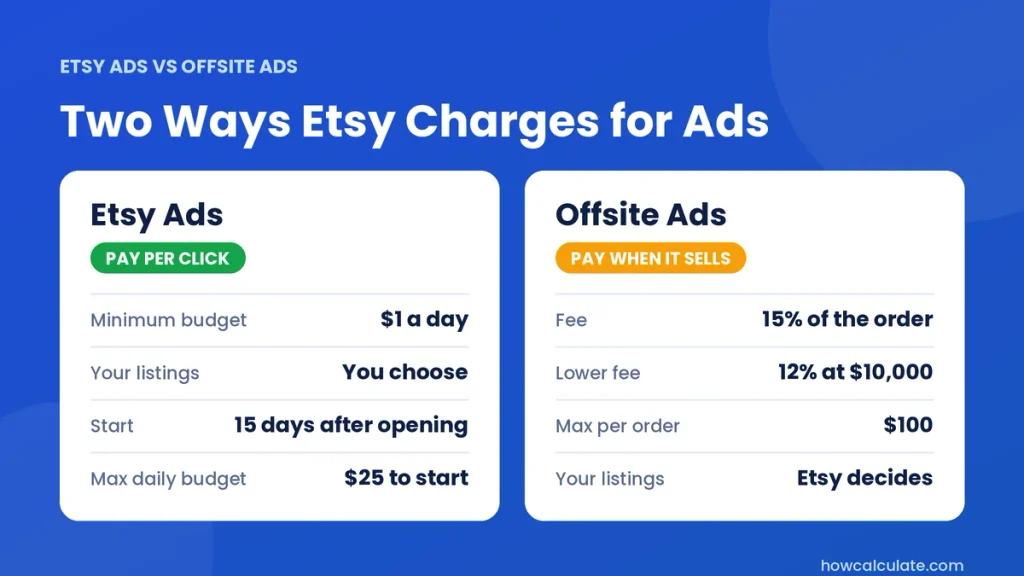
Etsy Ads put your listings in Etsy search results, category pages and market pages. You set a daily budget, and you pay only when someone clicks. Etsy also says you’ll never spend more than your daily budget.
To start, open Shop Manager, go to Marketing, choose Etsy Ads, select Get started and set your daily budget. A few things to know, all from Etsy’s help page:
- Waiting period: New shops have to wait 15 days after opening before starting a campaign.
- Minimum budget: It’s $1 a day, about $30 a month. At $5 a day it’s about $150.
- Daily limit: Every seller starts with a maximum daily budget of $25, and Etsy adjusts it weekly based on your spending.
- Strategies: You can choose a strategy per listing only if your budget is $25 or more. Below that, every listing uses Efficient Spending.
- Where ads show: Only to buyers in countries you ship to.
By default, Etsy advertises all your listings. I’d turn ads on only for the few listings that already sell, and leave the rest off until you see results. Etsy also suggests running a strategy for at least 30 days before judging it, so don’t change things every few days.
Etsy also sells a paid plan called Etsy Plus. If you’re weighing it up, see whether Etsy Plus is worth it.
4. Know how Offsite Ads work
Here’s the one that surprises people: you may already be in this program. Offsite Ads promote your listings on other sites, including search engines and social media. All sellers are enrolled automatically, and you can’t pick which listings get advertised.
You only pay if an ad click turns into a sale. The details, from Etsy’s Offsite Ads page:
- Fee: 15% if your shop has always made under $10,000 in any 365-day period, and 12% once it has made $10,000 or more.
- Cap: The fee on any single order never goes over $100.
- Time window: A sale counts if the buyer clicks the ad and buys from you within 30 days.
- Etsy Ads overlap: If the buyer’s last click before buying was an Etsy Ad, only the Etsy Ads charge applies.
- Opting out: Possible only if your shop has never reached $10,000 in any 365-day period. After that, it’s required for the life of the shop.
On a $30 order, a 15% fee is $4.50. Since you can’t predict which orders it will touch, I’d treat it as part of your cost when you set prices. We cover the full pros and cons in is Etsy Offsite Ads worth it.
5. Use Pinterest
People use Pinterest to look for ideas and save things they might buy later, which suits visual products like jewelry, home decor, wedding stationery and printables.
Set up a business account, make boards around your product types, and design vertical pins that link straight to the matching Etsy listing. Write real descriptions with the words people search for. A seller of printable wedding invitations could make separate pins for minimalist invitations, editable templates and wedding stationery, and see which ones get saved the most.
6. Post on Instagram and Facebook
Short videos work well for handmade items: the process of making it, the packaging, a close-up of the finished piece. Customer photos and reviews help too. Etsy lets you connect your social accounts from Shop Manager, as its promotion guide explains.
On Facebook, join groups where your buyers hang out, but read the rules first. Many ban links. Answer questions and share useful tips instead of dropping your listing link again and again.
7. Run a sale or coupon, after checking your margin
Etsy’s Sales and Discounts tool lets you run a sale (a percentage off or free standard shipping), make promo codes, and create discounted bundles. Etsy covers each option on its sales and discounts help page.
Before you use it, look at what a discount does to your profit. Say an item sells for $40 and you keep $20 before ads. A 20% sale takes $8 off, so you keep $12. You’d need to sell about 1.7 times as many items to earn the same total. Seasonal sales and one-off promo codes for a particular group (like a newsletter or a creator’s followers) are usually safer than shop-wide discounts.
8. Build an email list
An email list means you can tell people about new products without paying for clicks. Invite people to sign up through your social profiles or a signup page you own, and only email people who have clearly agreed. Follow Etsy’s policies and US email rules (CAN-SPAM), including a working unsubscribe link.
It takes time to build, but it’s the one audience you don’t rent from someone else.
9. Work with creators
You don’t need a big influencer. Smaller creators with an engaged audience in your niche often cost less and reach people who already care about what you sell. Look for creators who post about your type of product, check that their audience fits, and send a short, clear offer: free product, a flat fee, or a commission.
Give each creator their own Etsy promo code, so you can see who actually brings sales. Make sure sponsored posts and affiliate links are disclosed, as US rules require.
10. Ask happy buyers for reviews
Reviews help new shoppers trust you, which helps every other method in this list work better. A short, polite thank-you note in the package that asks for a review is enough. Check Etsy’s rules on requesting reviews first, and never offer a reward in return.
How to tell if your ads are paying off?
Clicks feel good, but they don’t pay your bills. Look at these numbers in Etsy’s ad reports:
- Impressions: How often your ad was shown.
- Clicks and CTR: How many people clicked, and the share of impressions that led to a click. You can work it out with our CTR calculator.
- Orders and revenue: Sales Etsy attributes to your ads.
- ROAS: Revenue from ads divided by what you spent on ads.
ROAS = ad revenue ÷ ad spend.
If you spend $50 and get $200 in ad sales, your ROAS is 4x. Our ROAS calculator does this for you. But 4x isn’t automatically profitable. It depends on how much you keep from each sale.
Here’s an example with illustrative numbers for a US seller. An item sells for $40 with free shipping:
- Product and packaging: $12
- Shipping you pay: $3.75
- Etsy fees (listing, transaction and payment processing): about $4.25
- What you keep before ads: $20, which is 50%
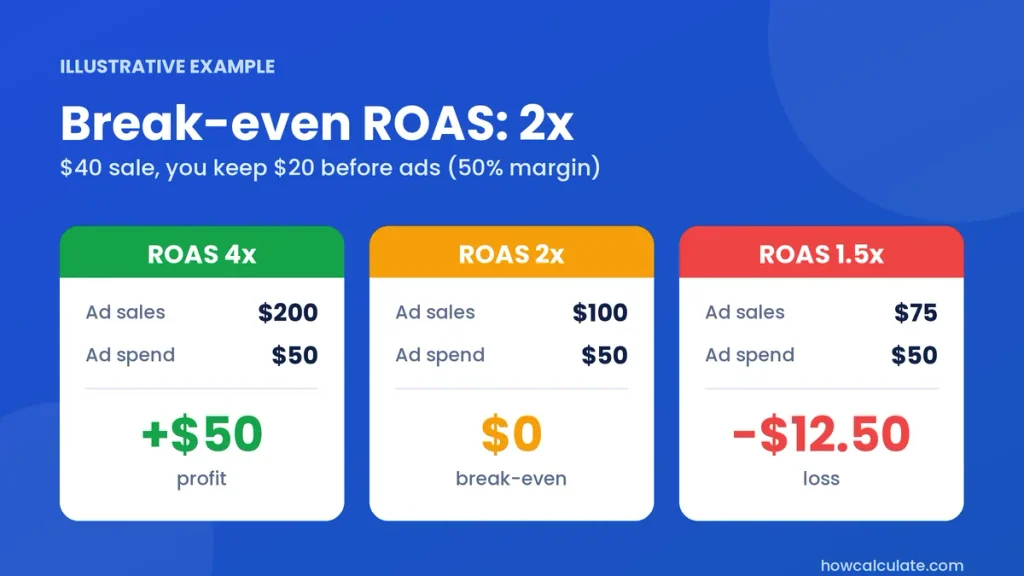
Break-even ROAS = 1 ÷ your margin before ads. With a 50% margin, that’s 1 ÷ 0.50 = 2x. At 2x, ads earn back exactly what they cost. Below 2x, you lose money, and above it, you make money. You can run your own numbers in the Break-even ROAS calculator.
Now apply it to the $50 campaign:
- At 4x ROAS: $200 in sales is 5 orders. You keep $100 and spent $50, so you make $50.
- At 2x ROAS: $100 in sales. You keep $50 and spent $50, so you make $0.
- At 1.5x ROAS: $75 in sales. You keep $37.50 and spent $50, so you lose $12.50.
If your margin were 25% instead, your break-even ROAS would be 4x. The thinner the margin, the more your ads need to earn. That’s profit before taxes and fixed costs like supplies or software. For help judging a result, see what is a good ROAS.
How to advertise an Etsy shop: which method to try first?
- New shop with no sales: Fix listings, work on Etsy search and start with free promotion like Pinterest.
- Views but no sales: Improve photos, price and description before spending on ads.
- Steady sales: Test Etsy Ads on your best sellers with a small daily budget.
- Visual products and a small budget: Put your time into Pinterest.
- Ads that already pay off: Raise the budget a little at a time, and check your ROAS after each change.
Frequently asked questions
How to advertise an Etsy shop for free?
Improve your listings and tags, post on Pinterest and Instagram, join relevant Facebook groups, build an email list and ask happy buyers for reviews. These cost time rather than money.
Can I advertise my Etsy shop for $1 a day?
Yes. Etsy’s minimum daily budget for Etsy Ads is $1. A small budget usually means fewer clicks, so it may take longer to learn what works.
Is Etsy advertising worth it for beginners?
It can be, once your listings are in good shape and already get some interest. Start small, then check whether your ROAS is above your break-even number before you spend more.
How long should I run Etsy Ads before judging them?
Etsy suggests running a listing strategy for at least 30 days before you evaluate it. A few days of clicks isn’t enough to tell.
What’s the difference between Etsy Ads and Offsite Ads?
Etsy Ads show your listings on Etsy, and you pay per click on a daily budget you set. Offsite Ads show your listings on other sites, and you pay a percentage fee only when an ad leads to a sale.
Can I promote my Etsy shop on Google?
Yes, in two ways. Etsy’s Offsite Ads can show your listings in search engine results, and good titles, accurate details and clear photos help your listings be found. You can’t buy Google ads through Etsy.
My take
If I were working out how to advertise an Etsy shop from zero, I’d get the listings right first, then spend a few weeks on Etsy search and Pinterest. Only after I had some sales would I try Etsy Ads, and then only on the listings that already sell, with a small budget.
Judge every paid method by break-even ROAS, not by clicks. And remember that Offsite Ads may already be taking a cut of some sales, so build them into your prices from the start.
About the author: Ajay Kumar is an SEO strategist and content writer who runs HowCalculate and builds its seller fee and marketing calculators. Read how we check our numbers.