Etsy vs Shopify: Which Costs Less, and When Does Shopify Pay Off?
Etsy vs Shopify isn’t a one-size answer. Sell a $30 item about 19 times a month, and Shopify’s monthly plan starts costing you less in fees than Etsy’s per-sale charges. Sell a $100 item, and that point drops to 6 orders. Sell a $15 item, and you’d need around 35.
But lower fees aren’t the same as more profit. The answer to “Etsy or Shopify?” depends on your price, your volume, and one cost most comparisons leave out: how you’ll get buyers.
Last updated: October 22, 2026. Fees checked against Etsy’s Fees & Payments Policy, Etsy Payments Policy and Shopify’s pricing page. All figures are for US sellers.
Etsy or Shopify? A 30-second check
Answer three questions, then jump to the section that fits you:
- What’s your typical item price? Under $20, Etsy’s fees stay lower for longer. Over $50, Shopify’s fees drop below Etsy’s after a handful of orders. See the break-even table.
- How many orders do you get a month? Below the break-even number for your price, Etsy’s fees are lower. Above it, Shopify’s are.
- Where do your buyers come from? If they find you through marketplace search, Etsy is doing your marketing. If they already follow you on social media or by email, Shopify lets you keep more of each sale. See getting buyers.
“Low price, few orders, no audience yet” points to Etsy. “Higher price, steady orders, people already know you” points to Shopify.
Etsy vs Shopify: which is better?
Etsy is better for new sellers of handmade, vintage or craft items who want shoppers without running ads. Shopify is better for sellers with steady sales and their own audience who want a brand they fully control. Etsy charges more per sale but brings buyers to you. Shopify charges a monthly fee and less per sale, but you find the buyers yourself.
What does it cost to sell on Etsy in 2026?
A typical Etsy sale costs a US seller about 9.5% of the order plus 45 cents in fees, or around 11% on a $30 item. There’s no monthly fee unless you choose the optional Etsy Plus plan.
- Listing fee: $0.20 per listing. Listings last four months. If a listing has more than one unit, Etsy renews it automatically for another $0.20 each time one sells, so an order of two units adds two renewal fees.
- Transaction fee: 6.5% of the price you display, plus whatever you charge for shipping and gift wrap. For US sellers, it doesn’t apply to sales tax.
- Payment processing fee: 3% + $0.25 per order, charged on the full order total, including shipping and tax.
- Offsite Ads fee: 15% of the order when a sale comes from one of Etsy’s ads on other sites, dropping to 12% once your shop passes $10,000 in yearly sales. It’s capped at $100 per order, and you only pay it when an ad leads to a sale.
- Etsy Plus (optional): $10 a month for extra listing and ad credits.
Shipping changes the math. If a buyer pays $5 shipping on a $30 item, both the transaction and processing fees are worked out on $35. That raises Etsy’s fees from $3.30 to about $3.78.
If you charge for gift wrap, that’s included in the transaction fee too. Our Etsy fee calculator doesn’t have a gift wrap field, so add the gift wrap charge to the shipping amount when you use it.
Refunds and discounts. If you refund an order, Etsy recalculates the processing fee on the new amount and credits you the difference. Listing fees aren’t refunded. Etsy’s fee policy doesn’t spell out exactly how coupons change the transaction fee, so check the fee lines on your own order statements.
More on the ad fee in our guide to whether Etsy Offsite Ads are worth it.
What does it cost to sell on Shopify in 2026?
Shopify charges a monthly plan fee plus a card processing fee on each order. The Basic plan is $39 a month, or $29 a month on yearly billing, plus 2.9% + 30¢ per online order.
- Basic: $39/month, or $29/month billed yearly. Online card rate 2.9% + 30¢.
- Grow: $105/month, or $79/month billed yearly. Online card rate 2.7% + 30¢.
- Advanced: $399/month, or $299/month billed yearly. Online card rate 2.5% + 30¢.
A few details change the real cost:
- Yearly billing is paid upfront. According to Shopify’s Help Center, annual billing charges the full year at once. On Basic, that’s $348, and plan charges are generally non-refundable. It saves $120 a year compared with monthly billing, but only if you’re sure you’ll stay.
- Other payment providers cost extra. The card rates above are for Shopify Payments. With a different provider, Shopify adds 2% on Basic, 1% on Grow or 0.6% on Advanced, on top of that provider’s own fees. See Shopify Payments vs Stripe.
- Refunds don’t return card fees. Shopify announced in its community forum that it no longer returns the original Shopify Payments fee when you refund an order.
- Intro offer: Shopify currently offers a 3-day free trial, then $1 a month for the first three months on most plans.
Extra costs Shopify doesn’t list on the plan
Etsy’s fees cover the whole storefront. On Shopify, a few things can cost extra:
- Themes: there are free themes, but many stores buy a paid one.
- Apps: reviews, email marketing and upsells often come from apps, and many charge monthly.
- Domain: you get a free myshopify.com address, but a custom domain is a yearly cost.
None are required, but most growing stores pay for at least one.
Etsy vs Shopify fees at different prices
The higher your price, the sooner Shopify’s fees drop below Etsy’s. Etsy’s fees grow with every dollar of the sale, while most of Shopify’s cost is a fixed monthly plan.
| Item price | Etsy fees per order | Shopify Basic fees per order | Shopify fees lower above (monthly billing) | Shopify fees lower above (yearly billing) |
|---|---|---|---|---|
| $15 | $1.88 | $0.74 | 35 orders | 26 orders |
| $30 | $3.30 | $1.17 | 19 orders | 14 orders |
| $50 | $5.20 | $1.75 | 12 orders | 9 orders |
| $100 | $9.95 | $3.20 | 6 orders | 5 orders |
Assumptions: US seller, one item per order (so one $0.20 listing fee per sale), free shipping for the buyer, no sales tax, gift wrap, discounts or refunds, no Offsite Ads, and Shopify Basic with Shopify Payments, with no themes, apps or domain costs. Yearly billing figures use Shopify’s $29 monthly rate, which is paid upfront as $348 for the year.
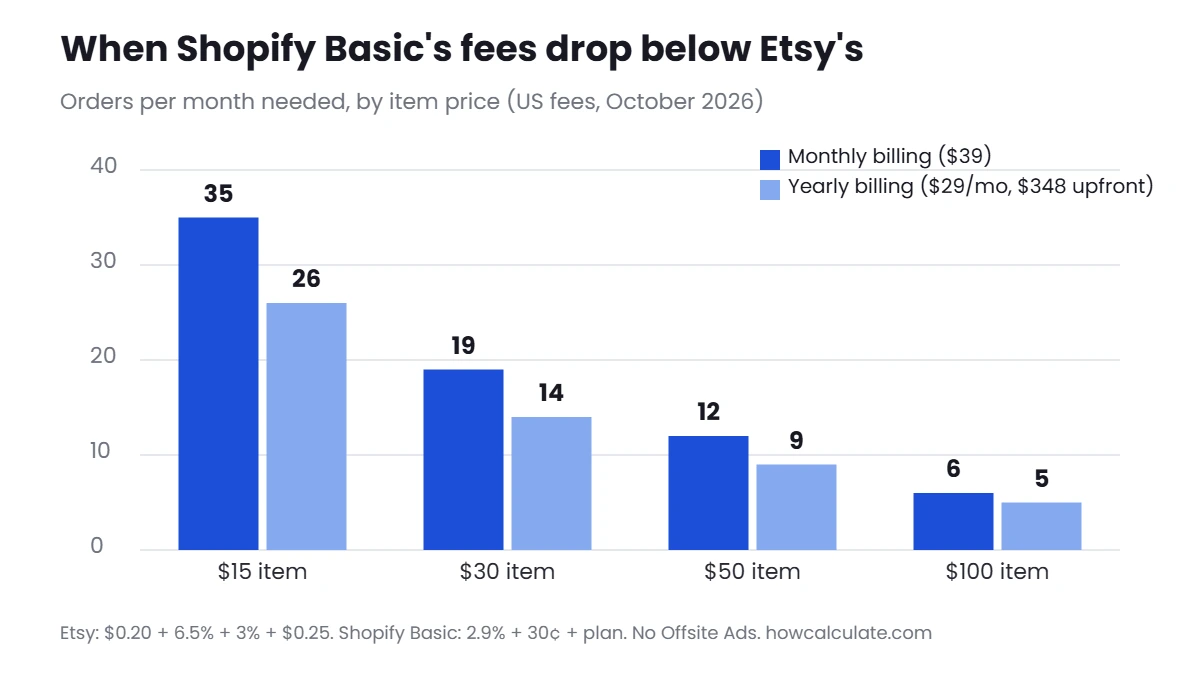
This is a platform-fee break-even, not a profit break-even. It shows when Shopify’s fees cost less than Etsy’s. It doesn’t include product costs, shipping labels, apps, or what it costs to bring buyers to your own store, and those can easily outweigh the fee difference.
At $30 a sale, monthly fees look like this:
- 10 orders: Etsy $33.00 vs Shopify $50.70 (or $40.70 on yearly billing)
- 50 orders: Etsy $165.00 vs Shopify $97.50 (or $87.50 on yearly billing)
- 200 orders: Etsy $660.00 vs Shopify $273.00 (or $263.00 on yearly billing)
Every Etsy sale that comes through an Offsite Ad adds another 12–15% to Etsy’s fees. Upgrading to Shopify’s Grow plan doesn’t help at these prices: at $30 a sale it saves only 6 cents per order, so it doesn’t cover its higher plan fee until around 1,100 orders a month.
To check your own price, open our Etsy fee calculator and Shopify fee calculator side by side.
How we calculated these numbers?
- Etsy fees per order: $0.20 listing fee + 6.5% transaction fee + 3% + $0.25 processing fee
- Shopify Basic fees per order: 2.9% + $0.30
- Break-even orders: monthly plan ÷ (Etsy fees per order − Shopify fees per order), rounded up. At $30: $39 ÷ $2.13 = 18.3, so 19 orders.
All rates come from the official Etsy and Shopify pages linked at the top. We rechecked every figure on the date shown.
The cost fee tables leave out: getting buyers
On Etsy, part of what you pay in fees buys you access to shoppers who are already searching. On Shopify, nobody finds your store unless you bring them. That’s where most of the real difference between Etsy and Shopify lies.
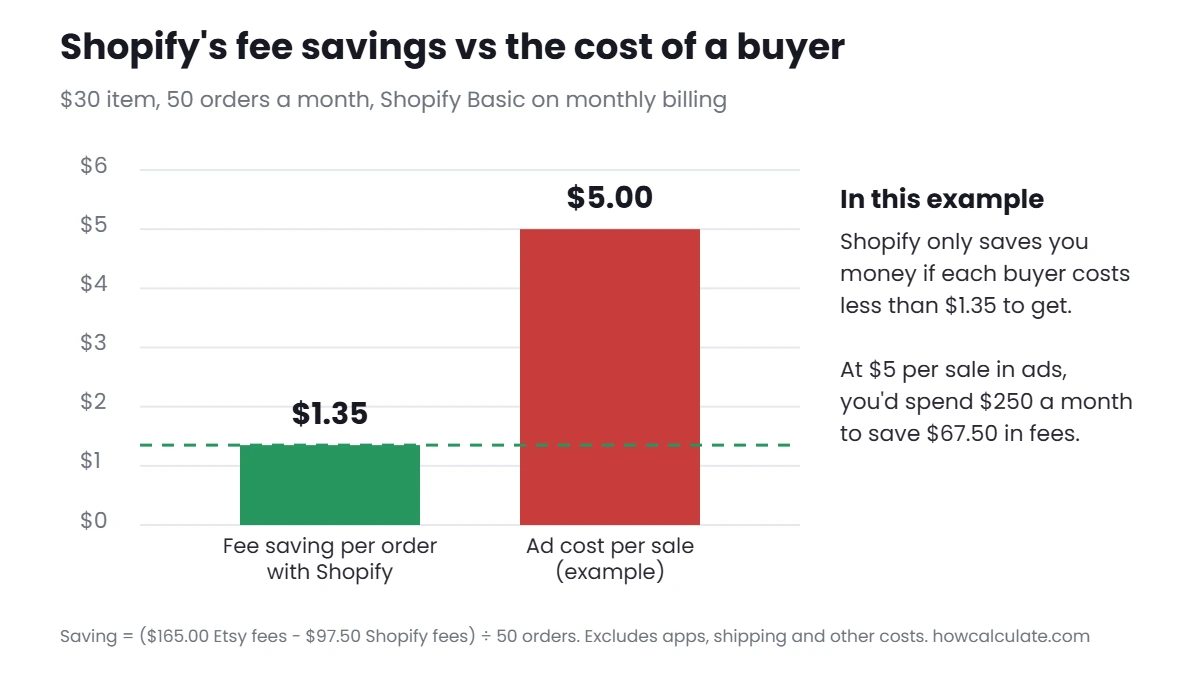
Here’s a simple way to compare. Take a $30 item selling 50 times a month on either platform. Shopify’s fees would save you $67.50 a month on monthly billing ($165.00 − $97.50), or $1.35 per order.
So, in this example, Shopify only comes out ahead if each buyer costs you less than about $1.35 in ads or other paid marketing. That assumes you’d make the same 50 sales on both platforms, and it leaves out other cost differences like apps or shipping. If ads cost you $5 per sale, you’d spend $250 a month to save $67.50 in fees. Our break-even ROAS calculator shows how much ad spend a product can take before it loses money.
That’s why Shopify works best when buyers come without paid ads, for example when:
- You have a following on Instagram, TikTok, YouTube or an email list
- Customers come back and buy again
- People search for your brand name directly
If none of that is true yet, Etsy’s higher fees are usually cheaper than paying for traffic.
Etsy vs Shopify beyond fees
Etsy is faster to start. Shopify gives you more control over almost everything else.
- Setup: an Etsy shop can be live in an afternoon. A Shopify store takes longer, because you set up the theme, pages, payments and shipping yourself.
- Design: Etsy shops look much the same. On Shopify, you control the whole look, with over 70 themes or a custom design.
- Customer data and email: under Etsy’s Seller Policy, you can use buyer details only for Etsy-related messages, and you can’t add buyers to your mailing list without their consent. On Shopify, you keep your own customer list and can send marketing emails to customers who’ve given marketing consent, as long as you follow the privacy and email rules that apply to your business.
- Competition on the page: Etsy shows other sellers’ products next to yours. A Shopify store shows only yours.
- Search: on Etsy, you optimize for Etsy’s search. On Shopify, you work on Google SEO, which is slower but builds traffic you own.
Who is Etsy best for, and who is Shopify best for?
Choose Etsy if you:
- Are just starting and don’t want a monthly fee
- Make products in small batches, like jewelry, art, candles or home decor
- Sell digital downloads or patterns
- Would rather spend time making products than running ads
Choose Shopify if you:
- Already have an audience that buys from you
- Sell many products, or products with lots of variations
- Run a model like dropshipping, print on demand or subscriptions
- Want to sell in several places, such as your own site, social media and in person
Large-scale manufacturers and resellers of mass-produced goods are usually a poor fit for Etsy, which is built around handmade and vintage items.
When should you move from Etsy to Shopify?
Consider adding a Shopify store when you’re steadily past the break-even number for your price, and enough of your buyers would follow you to your own site. Good signs:
- Repeat customers ask how to buy from you directly
- You’re building an email list or social following
- Offsite Ads fees are taking a noticeable share of your profit
You don’t need to close your Etsy shop. Shopify’s Etsy migration guide explains how to move products, and it points to third-party apps for orders, customers and reviews. One thing to know: Shopify’s Marketplace Connect help page says new Etsy connections can’t currently be made through that app. Sellers already connected can keep using it. If you want to run both stores, look for an inventory sync app that supports Etsy.
Etsy vs Shopify questions
Is Shopify cheaper than Etsy?
Shopify’s fees per sale are lower: 2.9% + 30¢ on Basic versus about 9.5% + 45¢ on Etsy. Whether your total costs are lower depends on your volume, since Shopify adds a monthly plan, and on what you spend to bring in buyers.
How much does Etsy take from a $100 sale?
About $9.95 with free shipping and no Offsite Ads: $6.50 transaction fee, $3.25 processing fee and $0.20 listing fee.
How much does Shopify take from a $100 sale?
$3.20 per order on the Basic plan with Shopify Payments, plus your monthly plan.
Does Etsy have a monthly fee?
No. The only monthly charge is the optional Etsy Plus plan at $10 a month.
Is Etsy or Shopify better for beginners?
Etsy is usually easier. There’s no monthly fee, setup is quick, and shoppers can find you through Etsy search from day one.
Is Etsy or Shopify better for selling art?
Etsy often suits new artists, because buyers already browse it for original art and prints. Shopify suits artists with an existing following who want full control over how their work is shown.
Is Etsy or Shopify better for print on demand?
Both can work. Print-on-demand margins are often thin, so Etsy’s fees take a bigger share. Shopify’s lower per-sale fees help once you have steady traffic.
Can you sell on Etsy and Shopify at the same time?
Yes, and many sellers do. Some use Etsy to find new customers and Shopify for repeat buyers. An inventory sync app that supports Etsy can help keep stock matched across both.
Before you decide
Real costs vary with your payment provider, shipping, sales tax, discounts, refunds, apps and marketing. The numbers here compare platform fees only, so use them as a starting point, not a final answer.
If nobody knows your brand yet, Etsy’s built-in shoppers are usually worth the higher fees. Once you’re selling past the break-even point for your price and buyers come back to you on their own, a Shopify store lets you pay less in platform fees on every sale. Check your own numbers with the Etsy fee calculator and Shopify fee calculator.