YouTube Advertising Cost: What You’ll Actually Pay
There is no price list for YouTube ads. Google runs an auction, so your YouTube advertising cost depends on how you bid, who you target and what you want viewers to do. That is why one person says they paid 3 cents a view and another says they paid $8 for every 1,000 impressions. Both can be true.
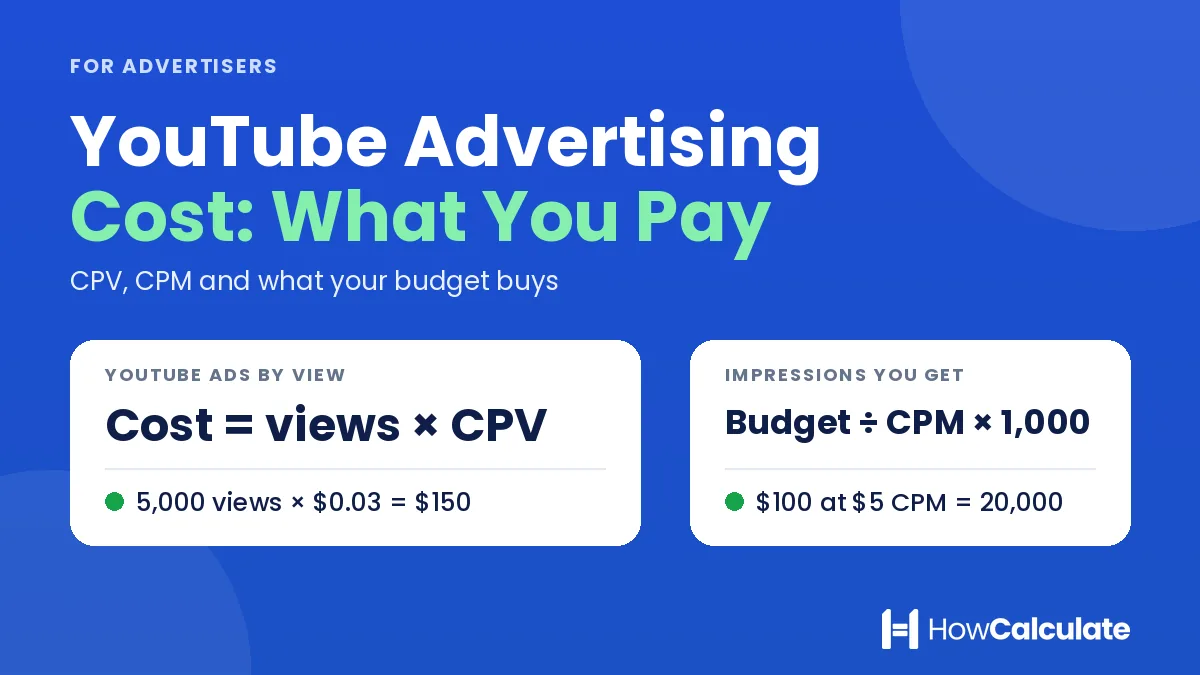
Here is a quick example. At a $5 CPM, $100 buys about 20,000 impressions. At a $10 CPM, the same $100 buys about 10,000. Your real numbers can land above or below these, so the useful question is how you are charged and what you want the money to do.
The short answer: YouTube advertising cost is set by auction. You usually pay per view or per 1,000 impressions, and your real price depends on your audience, ad format and goal.
How YouTube advertising cost is calculated
YouTube doesn’t bill every campaign the same way. Your campaign goal, ad format and bidding strategy decide whether you pay for views, impressions or something else. These are the terms you will see:
- CPV (cost per view): what you pay when someone counts as a view
- CPM (cost per 1,000 impressions): what you pay each time your ad is shown 1,000 times
- CPC (cost per click): your total spend divided by your clicks
- CPA (cost per acquisition): what it costs to get one lead, sale or sign-up
- ROAS (return on ad spend): the revenue you earn for each dollar of ad spend
CPV and CPM are the two ways YouTube usually bills you. CPC, CPA and ROAS are mostly results you work out afterwards to see if the ads paid off.
Cost per view (CPV)
With CPV bidding, you pay when someone watches your ad or interacts with it. For skippable in-stream ads, Google counts a view when someone watches 30 seconds, watches the whole ad if it is shorter than 30 seconds, or interacts with it, whichever comes first. Other formats follow different rules. In-feed ads, for example, bill when someone clicks to watch the video.
Cost = views × average CPV
Say you get 5,000 views at an average CPV of $0.03. Your cost is 5,000 × $0.03 = $150.
Google Ads now labels this metric “TrueView views” in reports. Billing didn’t change; only the name did.
CPV suits you when you want people to actually watch your video.
Cost per 1,000 impressions (CPM)
CPM is the price of showing your ad 1,000 times. Google bills bumper ads and non-skippable in-stream ads by impressions, so CPM is the number to watch for those.
CPM = (ad cost ÷ impressions) × 1,000
If you spend $200 and get 40,000 impressions, your CPM is ($200 ÷ 40,000) × 1,000 = $5.
CPM works best when you want as many people as possible to see your message. You can check your own numbers with the CPM calculator. It works in both directions, so you can also enter a budget and a CPM to see how many impressions you would get.
Cost per click (CPC)
CPC is your ad cost divided by your clicks. Spend $120, get 240 clicks, and your CPC is $0.50.
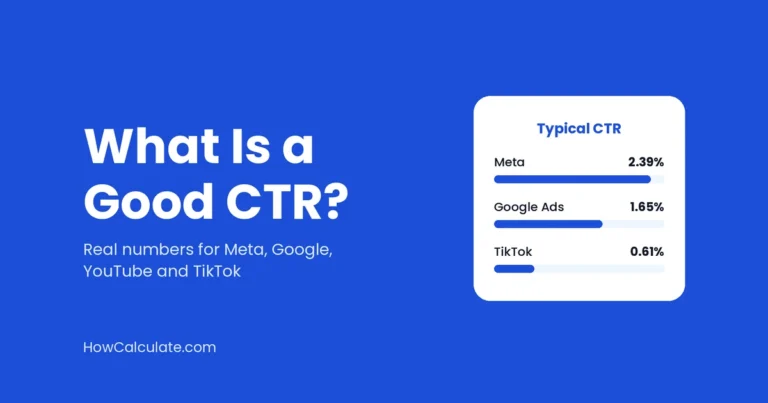
Don’t assume you are billed per click, though. Billing depends on the campaign type and ad format. Most video view and reach campaigns charge by views or impressions, so CPC is often just a number you work out afterwards. Some campaigns, like Demand Gen with click bidding, aim for clicks, so check the billing details in your own Google Ads account. To see how clicks compare with impressions, check your CTR. Our guide on what a good CTR looks like has typical figures.
Why you can’t compare CPV and CPM directly
Say you have $500 and you read three things: one site says $0.03 per view, another says an $8 CPM, and a third says spend much more. It looks like a mess, but those numbers measure different things.
CPV is the price of a view. CPM is the price of 1,000 showings. Neither one tells you how many customers you will get. A campaign with 50,000 impressions isn’t automatically better than one with 20,000. If the smaller one reaches people who are more likely to buy, it can be the better deal.
So decide what you want before you compare any prices.
What can your budget buy?
Here is what different budgets could buy at different CPMs. These are worked examples, not promised results.
| Budget | $5 CPM | $8 CPM | $10 CPM |
|---|---|---|---|
| $100 | 20,000 | 12,500 | 10,000 |
| $500 | 100,000 | 62,500 | 50,000 |
| $1,000 | 200,000 | 125,000 | 100,000 |
| $5,000 | 1,000,000 | 625,000 | 500,000 |
A lower CPM stretches your money further, but it doesn’t mean the campaign will work better. Reaching the right people matters more than getting the most impressions.
How much do 10,000 YouTube views cost?
If your goal is views, multiply 10,000 by your average CPV to see this part of your YouTube advertising cost.
- At $0.02 per view, 10,000 views cost $200.
- At $0.03 per view, they cost $300.
- At $0.05 per view, they cost $500.
- At $0.10 per view, they cost $1,000.
Paid views and impressions are not the same thing. Your ad can be shown to someone without that person counting as a paid view.
What is a normal YouTube advertising cost?
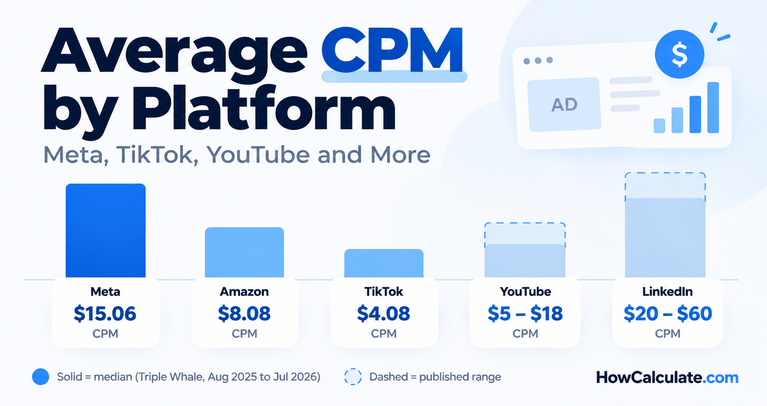
Google doesn’t set fixed prices, because it runs an auction, and third-party reports disagree with each other. Treat any number you read online as a rough starting point. The best benchmark is your own first small campaign. If you want a wider comparison, our guide to average CPM by platform shows how YouTube stacks up against other ad platforms, and our TikTok CPM guide covers the same idea for TikTok.
What affects YouTube advertising cost?
Your budget is only one piece. These things also move the price:
- Your audience. A broad audience gives your ads more room to find viewers. A narrow, high-value audience, like people shopping for expensive equipment, can cost more to reach but may be worth more to you.
- Competition. When many advertisers want the same viewers, the auction gets pricier. This is common for finance, software and other high-priced products.
- Your ad format. Skippable in-stream, non-skippable, in-feed, Shorts and bumper ads are all priced differently.
- Your location. The same campaign can cost very different amounts in the US, in one city or in a smaller market.
- Your bid and ad quality. In a CPV auction, Google says you pay only what is needed to rank above the next advertiser, not your full maximum bid.
- Your video. If people skip in the first few seconds, you waste impressions. A clear opening and a relevant offer help more than an expensive production.
- Your goal. A campaign built for cheap views will find people who watch, not necessarily people who buy.
Which ad format fits your goal?
- Skippable in-stream: good for explaining a product or service. You can pay per view or per impression, depending on your bidding.
- Non-skippable in-stream: the viewer has to watch your message. Billed by impressions.
- Bumper ads: short six-second messages. Billed by impressions.
- In-feed video: the viewer chooses to watch, so it works when your video is interesting enough to click.
- Shorts ads: short vertical video for people scrolling Shorts.
Is YouTube advertising worth it?
Your YouTube advertising cost can look low when you only count views, but cheap views don’t always mean cheap customers. Here is an example with made-up numbers. Two businesses each spend $500.
- Campaign A: $0.02 per view gives 25,000 views and 10 leads. That is $50 per lead.
- Campaign B: $0.05 per view gives 10,000 views and 35 leads. That is $14.29 per lead.
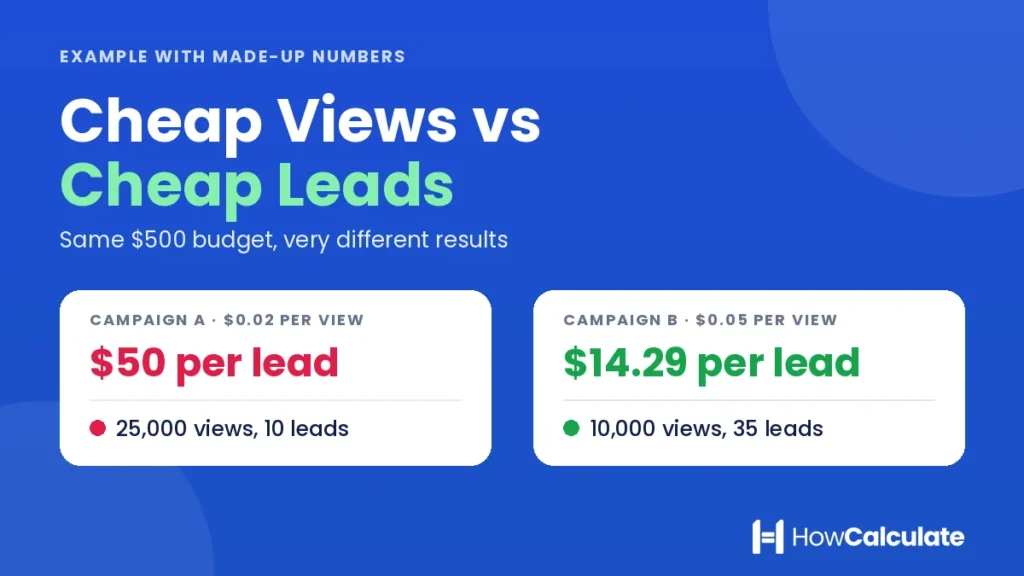
Campaign A wins on views, but Campaign B wins on leads. If you want leads, Campaign B is the better campaign.
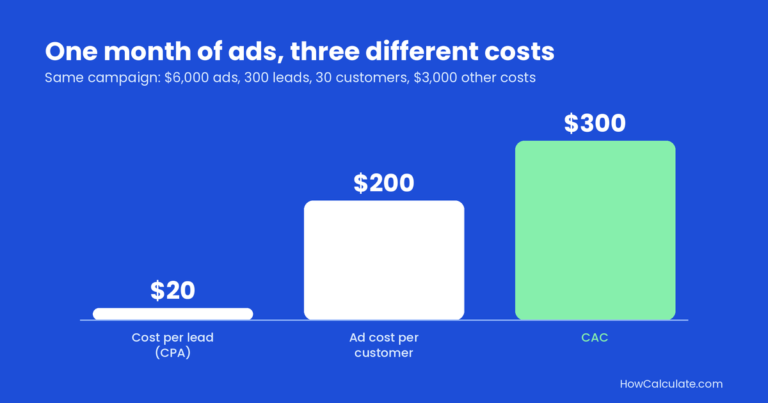
Judge each campaign by the result you care about. For reach, look at impressions. For traffic, look at clicks. For leads, look at cost per lead and use the CPA calculator; how to calculate CPA walks through it. For sales, check your ROAS and your customer acquisition cost.
How to set your YouTube ad budget
Don’t start with a random number. Work backwards from your goal to estimate your YouTube advertising cost.
- Pick one goal. Views, awareness, website visits, leads or sales.
- Set a target. For example, 50,000 impressions, 5,000 views or 50 leads.
- Estimate the cost. For impressions: budget = (target impressions × CPM) ÷ 1,000. For views: budget = target views × CPV.
- Do the math. If you want 50,000 impressions at an assumed $8 CPM, that is (50,000 × $8) ÷ 1,000 = $400.
- Start small and learn. Run a test, see which audiences and videos work, then raise your spend only when the results justify it.
Common mistakes that raise your YouTube advertising cost
- Comparing CPV and CPM directly. They measure different things.
- Chasing cheap views. A low CPV doesn’t guarantee leads or sales.
- Ignoring frequency. One person can see your ad several times. 100,000 impressions at a frequency of 4 reach only about 25,000 people.
- Skipping conversion tracking. If you want customers, track what happens after the view.
- Having no clear goal. Decide what success looks like before you pick a budget or a bidding strategy.
Quick answers
How much does YouTube advertising cost per 1,000 impressions?
That is your CPM. At a $5 CPM, 1,000 impressions cost $5. At a $10 CPM, 100,000 impressions cost $1,000. Your real CPM depends on your audience, bidding, format and competition.
Is $100 enough for YouTube ads?
It is enough to run a small test, try a couple of videos and collect first results. Whether it is enough to get leads or sales depends on your goal, your costs and how long your customers take to decide.
How much does 10,000 YouTube views cost?
It depends on your average CPV. At $0.02 per view it is $200, and at $0.05 it is $500. These are examples, not fixed rates.
Are YouTube ads cheaper than Google Search ads?
Not necessarily. YouTube ads introduce you to people through video, while Search ads reach people who are already looking for what you sell. Compare cost per lead and cost per customer, not just CPM or CPC.
Can I run YouTube ads without a website?
Often yes. Google says Demand Gen click campaigns work with YouTube video links as well as websites. But if you want leads or sales, a landing page makes results far easier to track.
Does YouTube charge for skipped ads?
It depends on how you bid. Under CPV bidding you pay for qualifying views or interactions, so a viewer who skips before 30 seconds usually doesn’t cost you a view. Under CPM bidding you pay for impressions, skipped or not.
Is this the same as what creators earn from YouTube?
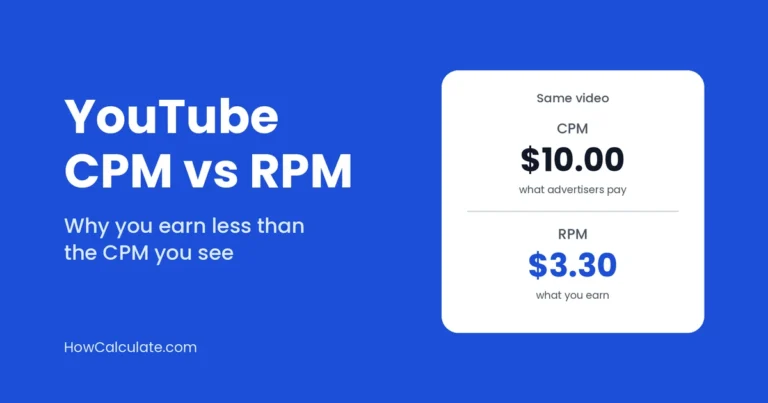
No. This guide is about what advertisers pay. If you want to know what creators earn, read YouTube CPM vs RPM.
Final verdict
YouTube advertising cost has no single price. You could spend $100 or $1,000, and the results depend on who you target, how you set up your campaign and what you ask viewers to do.
If you’re just starting, keep your budget small and learn what works. Judge awareness campaigns on reach, and judge lead or sales campaigns on cost per result. Don’t chase the cheapest views; aim for the right people at a price your business can justify.
Before you launch, run your own numbers in the CPM calculator to see how many impressions your budget could buy.
Pricing rules checked on Google Ads Help, November 2026. Google can change how it bills, so check your own account.