Selling on Etsy vs eBay: Which One Leaves You More Money?
Say you’ve got a $50 item ready to list, and you’re stuck choosing between selling on Etsy vs eBay. Both will take a cut. The question is how much, and whether that answer changes with the price, the item, or the way the buyer found you.
Here’s the short version. On a normal sale, Etsy is cheaper at every price we tested. On a $50 item, Etsy’s fees come to about $5.31 and eBay’s come to about $7.68. The catch is Etsy’s Offsite Ads. When a sale comes through one of those ads, Etsy’s cut on that order jumps to roughly 26%. If a large share of your orders come that way, eBay can end up cheaper. eBay also wins outright in a few categories, like guitars and athletic sneakers over $150.
Etsy vs eBay at a glance
| Etsy | eBay | |
|---|---|---|
| Main sales fee | 6.5% + 3% and $0.25 processing | 13.6% + $0.40 per order (most categories) |
| Listing fee | $0.20 every 4 months | 250 free a month, then $0.35 |
| Fees on sales tax | Only the 3% processing fee | The full 13.6% |
| Ads | Offsite Ads become mandatory past $10,000 in sales | Promoted Listings are always optional |
| What you can sell | Handmade, your designs, 20+ year vintage, craft supplies | Almost anything, new or used |
| Active buyers | About 87 million | About 136 million |
How Etsy and eBay charge sellers in 2026
Etsy (from its Fees & Payments Policy, updated October 2026):
- Listing fee: $0.20 per listing. It renews every four months, and again each time an item sells from a listing with more than one in stock.
- Transaction fee: 6.5% of the item price plus whatever you charge for shipping and gift wrap. For US sellers, it doesn’t apply to sales tax.
- Payment processing: 3% + $0.25 for US shops, charged on the total sale, including shipping and sales tax.
- Offsite Ads: an extra 12% or 15% on orders that come from Etsy’s ads. More on this below.
- Optional: Etsy Plus at $10 a month. Some new shops also pay a one-time setup fee when they open.
eBay (from its selling fees page):
- Insertion fee (eBay’s word for a listing fee): up to 250 free listings a month, or more if you have an eBay Store. After that, it’s $0.35 per listing. Some categories and listing types are excluded from the free allowance.
- Final value fee: 13.6% for most categories, plus $0.40 per order ($0.30 if the order is $10 or less). There’s no separate payment processing fee.
- What the fee is charged on: the total amount of the sale, which includes the item price, shipping, handling and sales tax.
- Optional ads: Promoted Listings, where you choose your own ad rate.
- Extra charges: 1.65% of the sale on international orders if you don’t use eBay International Shipping. If your account falls to “Below Standard,” eBay adds an extra 6% of the sale total to your fees.
A $50 sale, worked out on both platforms
Here’s one sale, line by line. The item is $50 with free shipping, and the buyer pays 7% sales tax, so the order total is $53.50.
| Etsy | eBay | |
|---|---|---|
| Listing fee | $0.20 | $0.00 (within free 250) |
| Main fee | 6.5% of $50 = $3.25 | 13.6% of $53.50 = $7.28 |
| Processing or order fee | 3% of $53.50 + $0.25 = $1.86 | $0.40 per order |
| Total fees | $5.31 | $7.68 |
| You keep | $44.69 | $42.32 |
Look at what the $3.50 of sales tax costs you. On Etsy, only the 3% processing fee touches it, so it adds about $0.11 to your fees. On eBay, the full 13.6% applies to it, so it adds about $0.48. That’s why eBay’s real cut usually lands around 15%, not 13.6%.
Etsy vs eBay fees at $10, $25, $50, $100 and $300
Same setup as above: US seller, standard category, free shipping, about 7% sales tax, no store subscription and no ads. Fees were checked against both official pages on October 22, 2026.
| Item price | Etsy fees | You keep on Etsy | eBay fees | You keep on eBay |
|---|---|---|---|---|
| $10 | $1.42 | $8.58 | $1.86 | $8.14 |
| $25 | $2.88 | $22.12 | $4.04 | $20.96 |
| $50 | $5.31 | $44.69 | $7.68 | $42.32 |
| $100 | $10.16 | $89.84 | $14.95 | $85.05 |
| $300 | $29.58 | $270.42 | $44.06 | $255.94 |
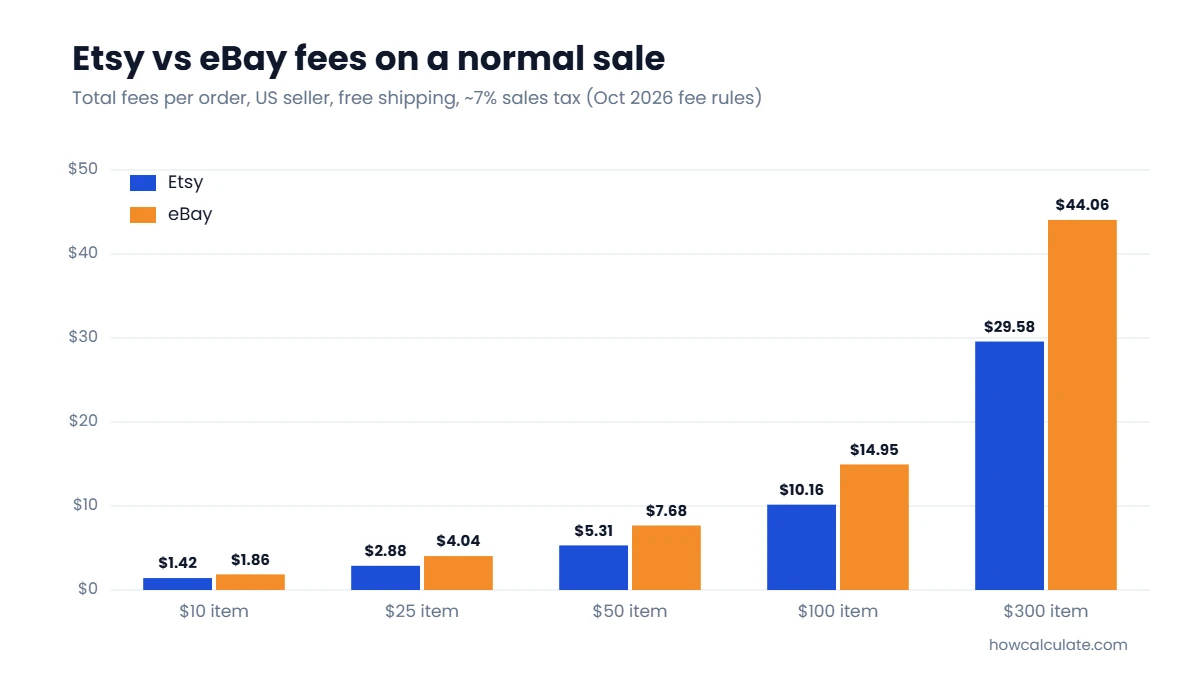
Etsy wins on every normal sale. Its total cut runs from about 14% on a $10 item down to about 10% on a $300 item. eBay stays around 15% to 16% at most prices, and close to 19% at $10. With tax added, a $10 item becomes a $10.70 order, so eBay charges the full $0.40 order fee.
The gap grows with price. At $25, Etsy saves you about $1.16 per sale. At $300, it saves you about $14.48.
To set your own price, shipping, and tax rates, use our Etsy fee calculator. It gives the same numbers as this table.
The Offsite Ads catch: when Etsy costs more than eBay
Etsy runs ads for sellers’ listings on search engines and social networks. If a buyer clicks one and orders from your shop within 30 days, you pay an extra fee on that order. The fee is charged on the item price plus shipping and gift wrap (not US sales tax), and it’s capped at $100 per order.
How much you pay, and whether you can say no, depends on your shop’s sales:
- Under $10,000 in the past 365 days: the fee is 15%, and you can opt out.
- $10,000 or more: the fee drops to 12%, but participation becomes mandatory. Etsy checks this on the first day of each month. Once you cross the line, you stay in the program at 12% for the life of your shop, even if your sales fall later.
- What counts toward the $10,000: item price times quantity, minus discounts and canceled orders. Shipping, tax, and gift wrap don’t count.
That’s the big difference from eBay, where Promoted Listings are always optional.
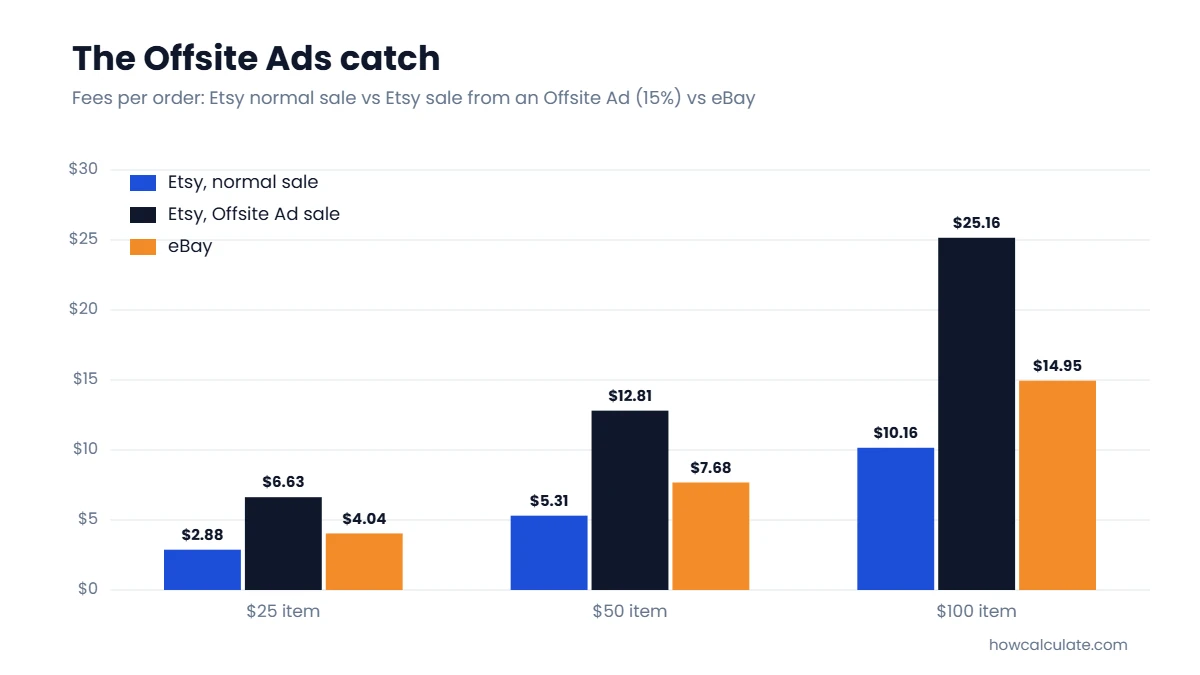
On a single Offsite Ad order, Etsy is much more expensive than eBay. A $50 sale costs $12.81 in fees, compared with $7.68 on eBay. But not every sale comes from an ad, so what matters is your mix.
A rough guide, not a fixed rule: at the 15% rate, Etsy’s average cost per order catches up with eBay’s when about one in three of your orders come through Offsite Ads. At the 12% rate, it takes about two in five. Below that share, Etsy is still cheaper overall. Your exact break-even point will shift a little with your prices, shipping, and tax.
You can see how many of your orders are ad-driven in Etsy’s Shop Manager under Marketing. For a deeper look, read Are Etsy Offsite Ads worth it? Our Etsy fee calculator also lets you add a 12% or 15% Offsite Ads fee to any sale.
Where eBay is the cheaper choice?
eBay’s 13.6% is just the standard rate. A few categories pay much less.
Guitars and basses (Musical Instruments & Gear > Guitars & Basses). eBay charges 6.7% on the sale total up to $7,500, and 2.35% on any amount above that. Listings in this category are also free. On a $500 vintage guitar, eBay’s fees come to about $36.25, while Etsy’s come to about $49.00. That’s roughly $12.75 more in your pocket on eBay.
Athletic sneakers (Men’s and Women’s Athletic Shoes). If the sale total is $150 or more, eBay charges 8% and skips the $0.40 order fee. Below $150, the normal 13.6% applies. On a $200 pair with 7% tax, that’s about $17.12 in fees, compared with about $29.50 at the standard rate. Etsy doesn’t allow most new resold shoes, so for sneaker resellers this one is easy.
Lots of slow-moving listings. Etsy charges $0.20 every four months for each listing, whether it sells or not. A shop with 300 items that rarely sell pays about $180 a year just to keep them listed. On eBay, most sellers can list 250 items a month for free.
A few eBay categories cost more than the standard rate. Books, movies and music pay 15.3%, and most jewelry pays 15%. In those categories, Etsy’s lead gets even bigger.
What you can actually sell on each platform?
Fees only matter if the platform allows your item.
Etsy is strict. Under its Creativity Standards, everything you sell has to fit one of four groups:
- Made by you: handmade items, or items you produce yourself with tools like a 3D printer or Cricut
- Designed by you: your original designs, including digital downloads and print-on-demand products
- Handpicked by you: vintage items that are at least 20 years old, items from nature, and themed gift baskets
- Sourced by you: craft supplies, party supplies, and items personalized with the buyer’s text or photo
That rules out reselling new, ready-to-use products, like store-bought sneakers, a wholesale phone case or a jacket from 2015.
eBay has almost no such limits. New, used, refurbished, collectibles, electronics, car parts, clothes from your closet: if it’s legal and allowed by eBay’s policies, you can list it. You can also choose between a fixed price and an auction, which helps with rare items when you don’t know what they’re worth.
For many sellers, this decides it. A reseller can’t use Etsy. A handmade candle maker can use both, but will likely do better on Etsy.
Etsy or eBay for vintage items?
Vintage is where both platforms are a real option.
Etsy only counts an item as vintage if it’s 20 years or older, and it may ask for proof, like photos or details about its age and source. In return, you get lower fees and buyers who are often hunting for a certain style or era, like 1970s home decor or 1990s clothing.
eBay accepts items of any age. It tends to work better for vintage pieces people search for by exact name or model, like a specific camera, watch or toy. Auctions also help when you’re not sure what a rare piece is worth.
Many vintage sellers use both. They put style-driven pieces on Etsy and collector items on eBay.
Buyers and how fast things sell
eBay is the bigger marketplace, with about 136 million active buyers in mid-2026, according to its Q2 2026 results. Etsy had about 87 million, according to its Q2 2026 shareholder letter.
Size isn’t everything, though. Shoppers on each site often behave a little differently:
- On Etsy, many buyers are looking for something unique, personal or handmade, so photos, story and customization often matter as much as price.
- On eBay, many buyers search for a specific model, part or size and compare prices, so a good deal can sell quickly, but there’s more pressure on price.
These are patterns, not rules. Plenty of people shop both ways on both sites. As a rough example, a $40 custom name necklace usually fits Etsy better, and a used $40 game controller usually fits eBay better.
So, should you sell on Etsy or eBay?
Etsy is usually the better fit if:
- You make, design or personalize your products
- You sell vintage items that are 20+ years old, or craft supplies
- Your prices are mid to high, where Etsy’s lower percentage saves real money
- Most of your orders come from Etsy search, not Offsite Ads
eBay is usually the better fit if:
- You resell new or used products that aren’t handmade or vintage
- You sell guitars, athletic sneakers over $150, collectibles or parts
- You have lots of listings that sell slowly
- A big share of your Etsy orders come through Offsite Ads
If you’re also weighing your own website, our Etsy vs Shopify comparison shows the order count where a Shopify store starts costing less than Etsy.
Can you sell on both Etsy and eBay?
Yes, and plenty of sellers do, especially vintage sellers. Two platforms put your items in front of more buyers and protect you if one of them changes its fees or rules.
The main risk is selling the same one-of-a-kind item twice. If it sells on eBay while it’s still live on Etsy, you’ll have to cancel an order, which can hurt your seller standing. Cross-listing tools can sync your stock, but they charge a monthly fee, so they make the most sense once you have enough listings.
Some sellers also add TikTok Shop as a third channel. Its 6% referral fee is lower than both, though creator commissions can push the real cost higher. Our TikTok Shop fee calculator shows what you’d keep at any price.
Frequently asked questions
Is it more profitable to sell on Etsy or eBay?
On fees alone, Etsy usually leaves you more per sale: about 10% to 14% in fees versus about 15% to 19% on eBay once sales tax is counted. Real profit also depends on what you sell and how fast it sells. eBay can be more profitable for resold goods, guitars and sneakers over $150, or if many of your Etsy orders come through Offsite Ads.
How much does Etsy take from a $100 sale?
$9.95 before tax: a $0.20 listing fee, a $6.50 transaction fee and $3.25 in payment processing, so you keep $90.05. With 7% sales tax, it’s about $10.16. If the sale came through an Offsite Ad, add $15 at the 15% rate or $12 at the 12% rate.
How much does eBay take from a $100 sale?
$14.00 before tax in most categories: a 13.6% final value fee ($13.60) plus the $0.40 order fee, so you keep $86. Because eBay also charges on sales tax, it’s about $14.95 with 7% tax.
What is the downside of selling on Etsy?
The biggest ones are Offsite Ads, which add 12% to 15% on some orders and become mandatory once your shop passes $10,000 in yearly sales, and the $0.20 listing fee that renews every four months even if nothing sells. Etsy also only allows handmade, vintage, your own designs and craft supplies, so resellers can’t use it.
Does eBay charge fees on sales tax?
Yes. eBay’s final value fee applies to the total amount of the sale, including sales tax. On Etsy, only the 3% payment processing fee applies to tax.
Can you sell non-handmade items on Etsy?
Only in certain groups: vintage items at least 20 years old, craft and party supplies, your own designs made by a production partner, and items personalized for the buyer. Reselling new, ready-to-use products isn’t allowed.
Does eBay charge listing fees?
Usually not. Most sellers get 250 free listings a month. After that, each new listing costs $0.35, and optional upgrades like bold titles cost extra.